What Is a Plastic Pallet Box? A Steel & Wire Cage Alternative
What Is a Plastic Pallet Box? A Steel & Wire Cage Alternative
Quick answer: a plastic pallet box is a reusable, enclosed industrial container made from HDPE or PP that sits on a pallet footprint and takes over the storage, transport and containment duties usually handled by steel cages, wire mesh containers or wooden crates. Two constructions dominate the category: the one-piece molded enclosed box and the honeycomb panel box, which can be assembled, folded and nested to reduce empty-return space.
Buyers researching this category usually arrive with three questions at the same time: what actually counts as a pallet box, which construction suits a medical, heavy-industry or home-logistics project, and why HDPE has become the default material for oil and water waste containment and for automotive parts. This guide answers those questions in order, then shows how a workable project specification is assembled step by step.
TOYOE is the pallet box brand of Zhangjiagang Fenghui Logistics Equipment Co., Ltd., a manufacturer founded in June 2010 in Zhangjiagang, Suzhou, Jiangsu, China. The company produces plastic pallet boxes, storage boxes, plastic crates and honeycomb panel boxes, with exports reported at roughly 40% of output and Mexico and the United States listed as its main markets.
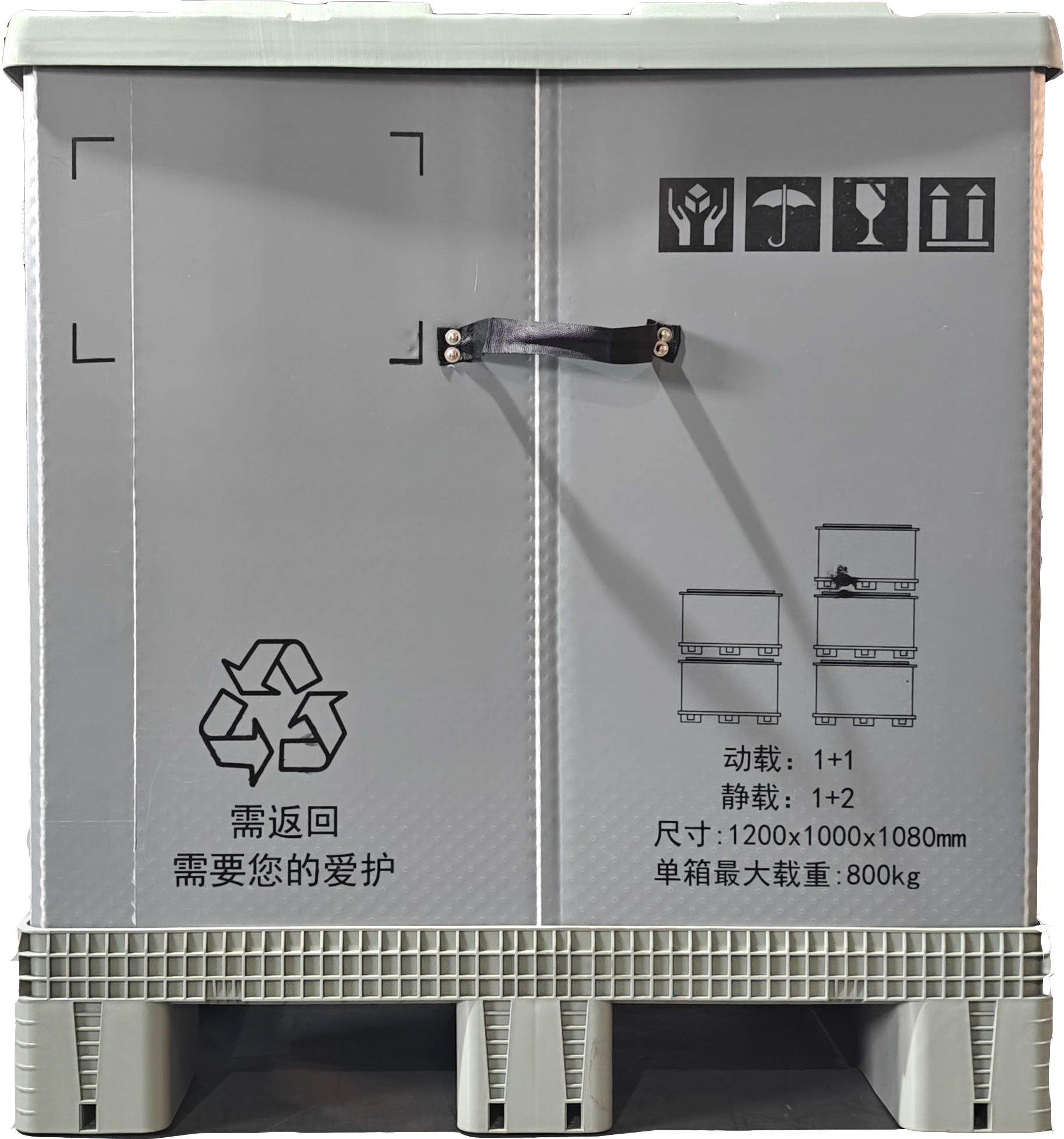
An enclosed plastic pallet box with an integrated handle: the closed body is what separates the category from open cages and mesh containers.
Problem Definition: Where Steel Cages and Wire Containers Stop Working
Steel cages and wire mesh containers are strong, familiar and widely available. They also carry a set of structural limits that show up as soon as the project involves moisture, liquids, finished surfaces or empty-return logistics.
- Open structure, no containment. Cages and mesh baskets are typically not designed to retain liquid, sludge or fine debris. Any oil film, coolant residue or wash-down water escapes the container and reaches the floor.
- Corrosion under humidity and washing. In humid, damp or frequently washed environments, coated steel typically needs ongoing inspection, touch-up and replacement. Wire contact points are usually the first places to show it.
- Contact marks on finished parts. Where mesh or frame members touch machined, painted or cast parts, marking and scratching risk rises. Cages usually need a separate lining added to solve this.
- Empty containers still occupy floor space. A rigid cage that does not fold or nest keeps consuming warehouse and truck volume even when it holds nothing.
A representative Mexican logistics warehousing and packaging project shows exactly the conditions under which this trade-off flips toward plastic: high humidity, dust, a wide temperature range, a waterproof and anti-static requirement, 24/7 operation, and handling by forklift and warehouse shelving, with moisture-proofing, shock resistance and stable load-bearing listed as the special requirements. That combination is difficult to satisfy with an open steel frame.
Industry Background: A Category That Keeps Expanding
The pallet box category is large and still growing. One commercial research estimate values the global pallet box market at USD 2.19 billion in 2024, with a forecast of USD 3.02 billion by 2032. A second commercial estimate, covering a broader definition that groups pallets, crates and containers together, puts 2024 at USD 12.76 billion and projects USD 23.40 billion by 2033 at a 6.9% CAGR.
The gap between those two numbers is a definition gap rather than a growth disagreement. Buyers comparing market reports should check whether the scope covers only enclosed pallet boxes or also includes pallets and large bulk containers, because the same category name can produce valuations that differ by a factor of five.
On the supply side, China is the dominant exporter of plastic boxes, cases, crates and similar articles under HS 392310, with an export value of USD 2.33 billion recorded in 2022. Plastic pallet boxes are classified under HS Code 3923100000, which is the classification TOYOE products are shipped under from Suzhou, China.
For a procurement team, the practical reading of this background is simple: the material supply is deep, the export infrastructure from China is mature, and the differentiation between suppliers sits in construction design, inner-lining capability and delivery reliability rather than in raw material availability.
Molded vs. Honeycomb Panel Designs: How the Two Constructions Differ
Almost every plastic pallet box on the market today belongs to one of two families. Choosing between them is the single most consequential decision in a project, because the construction determines weight, containment behaviour, customization ceiling and how the boxes behave when empty.
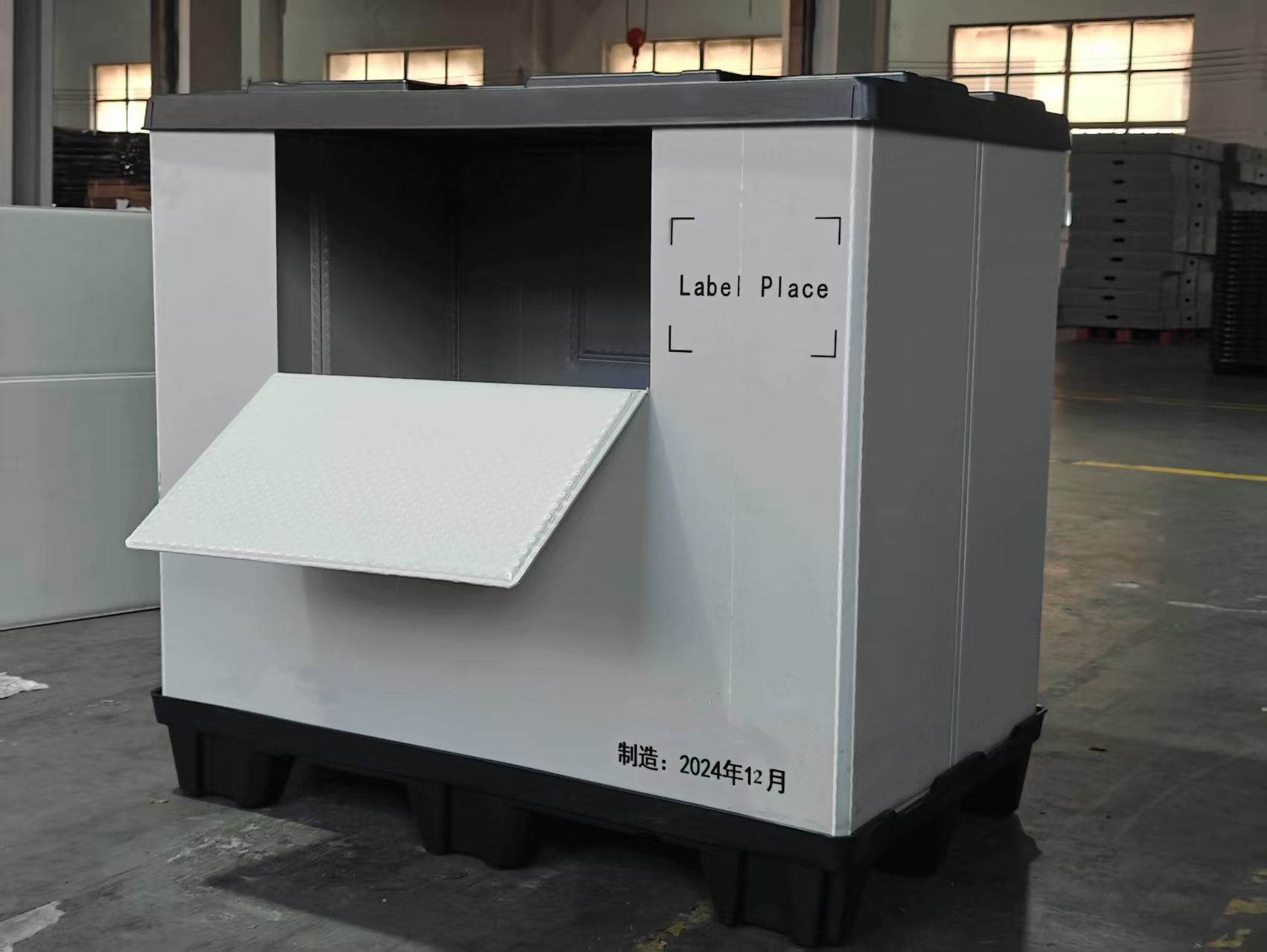
Honeycomb panel construction: the box body is built from blow-molded honeycomb board panels, which allows assembled and foldable formats.
1. The molded enclosed box
A molded enclosed box is produced as a self-supporting body in HDPE or PP with a closed, sealed wall structure and an enclosed top or lid arrangement. Because the walls are continuous, the box behaves as a containment vessel rather than a rack. This is the format used for liquid and semi-liquid duties and for parts that must be shielded from dust and moisture. In the current TOYOE range, the enclosed type is specified for oil, industrial alcohol, alkali, acid, industrial wastewater, water and car parts, with a usable capacity band of 100–200 L.
2. The honeycomb panel box
A honeycomb panel box, listed in the TOYOE range as a blow-molded honeycomb board box and in die-cast honeycomb board form for engine applications, is built from rigid sandwich panels. That construction supports sleeve-and-base assemblies, demountable formats and folding formats — the assembled box, the sleeve folding pallet box and the folded pallet box all belong to this family. Panel construction is the reason a large box can be collapsed to a fraction of its erected height for return transport.
Both families share the same material base, HDPE and PP, and the same declared feature set: recyclable, durable and nestable, with customizable size, color, logo and specification. Both are stated as suitable across automobile manufacturing, precision electronics, food cold chain, home logistics, medical and health care, and heavy industry.
| Project requirement | Molded enclosed box | Honeycomb panel box |
|---|---|---|
| Liquid and waste containment | Continuous wall; specified for oil, alkali, acid and industrial wastewater | Panel joints must be assessed against the medium before use |
| Empty return volume | Nestable when the format allows | Foldable and demountable; fold ratios up to 5:1 |
| Large-size coverage | Practical up to medium sizes | Well suited to 1200×800 type footprints |
| Typical duty | Wet, contamination-sensitive and ESD-controlled loads | Heavy, bulky parts and space-constrained return logistics |
Why HDPE Pallet Boxes Are Chosen for Oil and Water Waste Containment
HDPE and PP are specified for containment duties because they do not corrode, they tolerate washing and humid service, and they can be molded into a closed body with no seams through the liquid zone. Those three properties map directly onto the containment problem: the container has to hold the substance in, survive the environment around it, and keep doing both after repeated handling.
In the current TOYOE specification, the enclosed pallet box carries a capacity band of 100–200 L and is listed for oil, industrial alcohol, alkali, acid, industrial wastewater and water, alongside car parts. The same box is also declared for medical and health care, heavy industry and home logistics applications, which is why the enclosed format is often the default starting point for mixed-fleet projects.
Recyclability matters here for a different reason. Because HDPE and PP are recyclable thermoplastics, an end-of-life box returns to the material stream instead of becoming coated steel scrap with mixed contamination. Durability and recyclability together are what make the container economics work over a multi-year project rather than a single shipment.
Why HDPE Pallet Boxes Fit Automotive Parts Logistics
Automotive parts logistics is where the containment argument and the protection argument meet. Castings, gearboxes and machined components are heavy, dimensionally unforgiving and easily damaged by point contact. A die-cast honeycomb board pallet box built to the 1230×830×1000 mm format is designed for exactly this duty: engine and powertrain parts carried in an enclosed body rather than an open frame.
Enclosed pallet boxes in automotive parts storage, where dust, moisture and contact damage all have to be controlled at the same time.
A documented three-year project illustrates the pattern. An automobile manufacturer in Mexico uses 1,000 pieces of pallet box to store car transmission gearboxes. The reported result is standardized storage of auto parts, avoidance of collision damage to the gearbox, and improved warehouse management efficiency, with high load-bearing capacity, shock resistance and a stable structure cited as the deciding factors, along with a box size that fits the transmission gearbox precisely.
That last point is the one buyers most often underestimate. A gearbox or engine casting does not sit well in a generic container; the fit between part geometry and box interior is what converts a storage box into a handling system. Custom inner linings make that fit repeatable.
Nesting and Folding: The Empty-Return Advantage
Containers spend a large part of their life empty. Foldable pallet boxes can reach a fold ratio of up to 5:1, meaning five folded boxes occupy the space of one erected box and empty volume can be cut by up to 75%. Nestable designs deliver a similar effect by letting boxes stack into each other rather than on top of each other.
For a project sizing exercise, this changes three numbers at once: the number of trucks needed for container returns, the warehouse area reserved for empty containers, and the number of containers a closed loop can sustain before additional purchases are required. Where a rigid steel cage forces a choice between paying for empty return freight or buying a second fleet, a folding or nesting plastic box keeps one fleet circulating.
Design and Customization Options in the TOYOE Range
TOYOE operates on an OEM/ODM basis and customizes dimension, logo, color and material. Standard references in the current range include the 1200×800×1000 mm plastic pallet box, the 1000×800×800 mm storage pallet box, the 1000×800×800 mm plastic honeycomb panel box and the 1230×830×1000 mm die-cast pallet box for automotive engines.
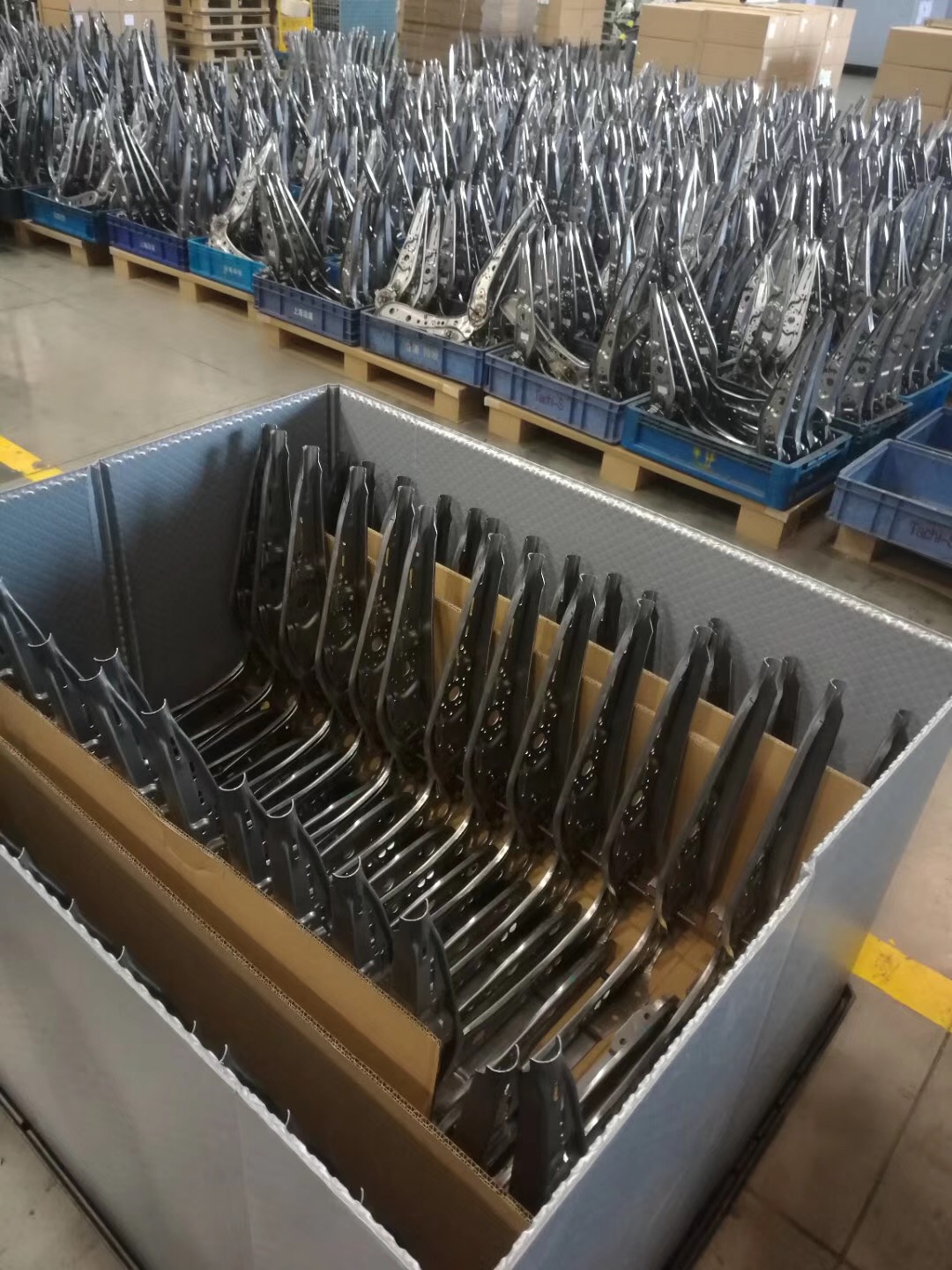
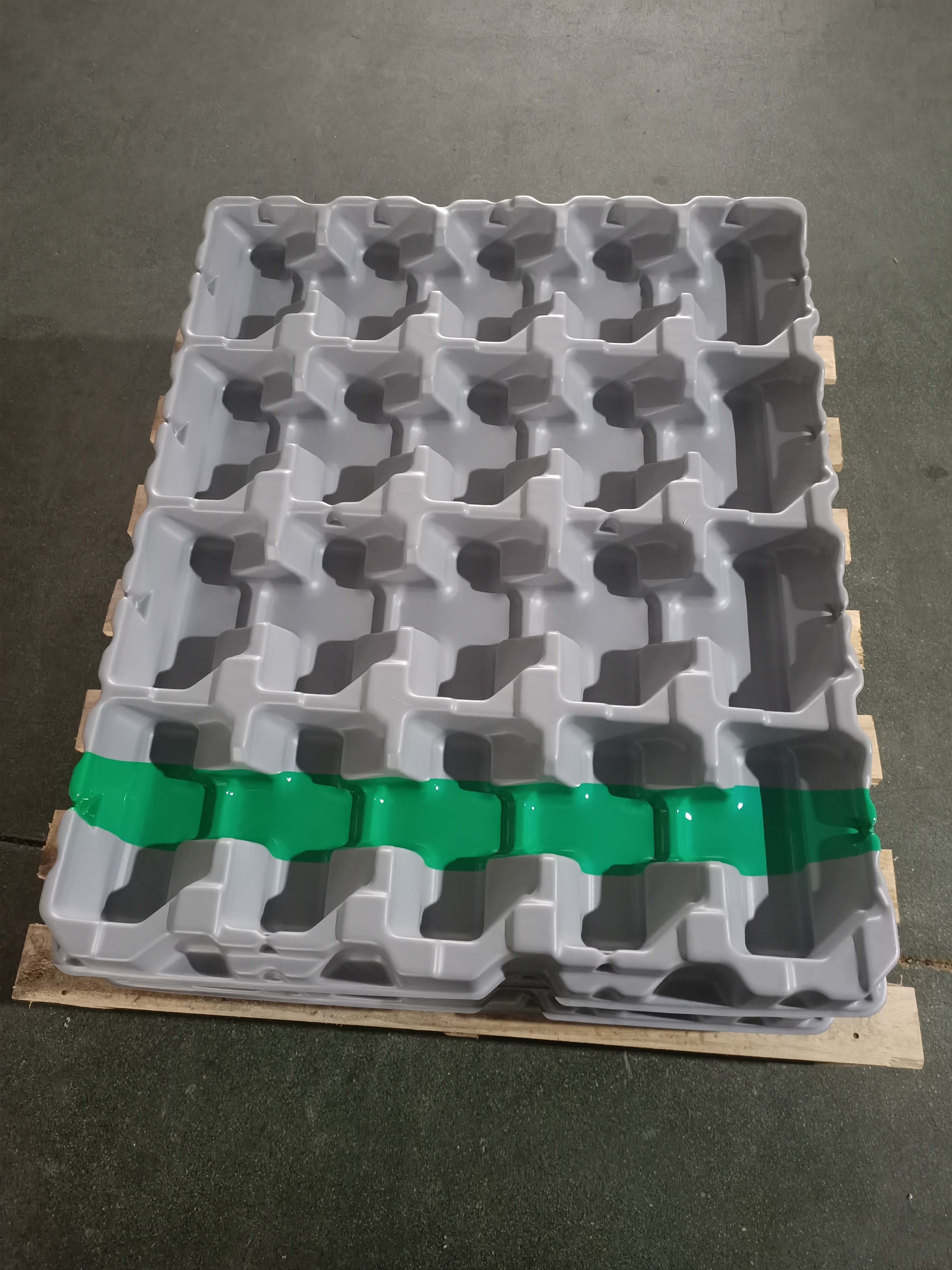
Inner lining design: vacuum-formed trays are shaped to the part so that position, spacing and protection stay identical from one box to the next.
Inner lining is the strongest lever in the whole specification. Available lining formats include booster vacuum-formed inner lining trays, heavy-duty vacuum-formed inner lining trays, transmission blister inner lining trays and anti-static blister trays. The choice determines how a part is located inside the box, how much shock the box can absorb on the part's behalf, and whether the interior can support an electrostatic discharge controlled environment.
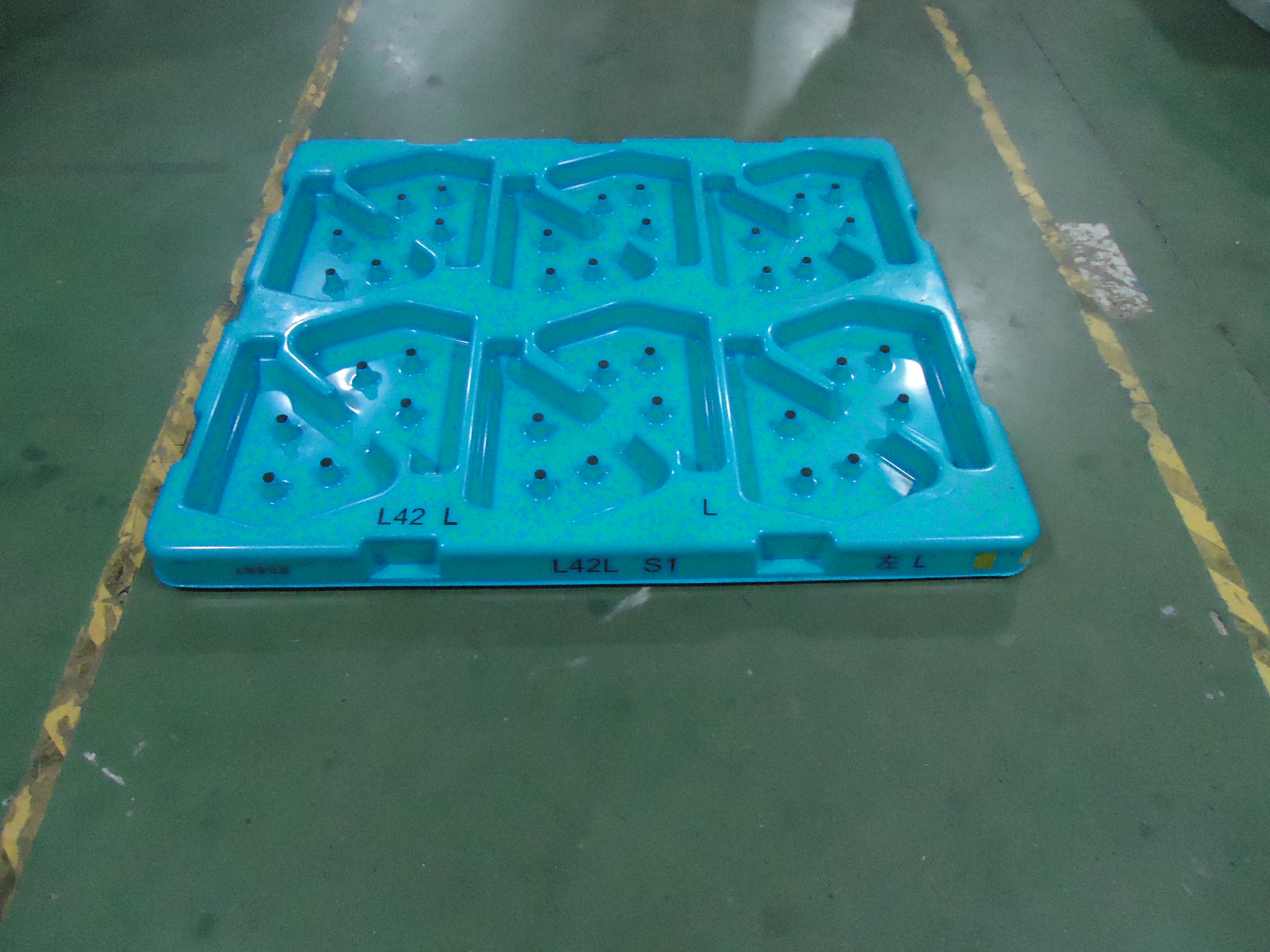
An anti-static blister tray converts a standard enclosed box into an ESD-controlled interior for precision electronics projects.
On the manufacturing side, the company reports a 4,000 m² factory, 34 employees, two R&D engineers, an annual output of 30,000 units and a monthly capacity of around 3,000 pieces, with OEM/ODM production, a minimum order quantity of one unit, a 7–15 day lead time, a 50% test regime in quality control, and a five-year after-sales guarantee that excludes damage from human error or excessive storage weight. Boxes in the range are supplied with plastic film packing, customized color, free logo printing and the classification HS Code 3923100000.
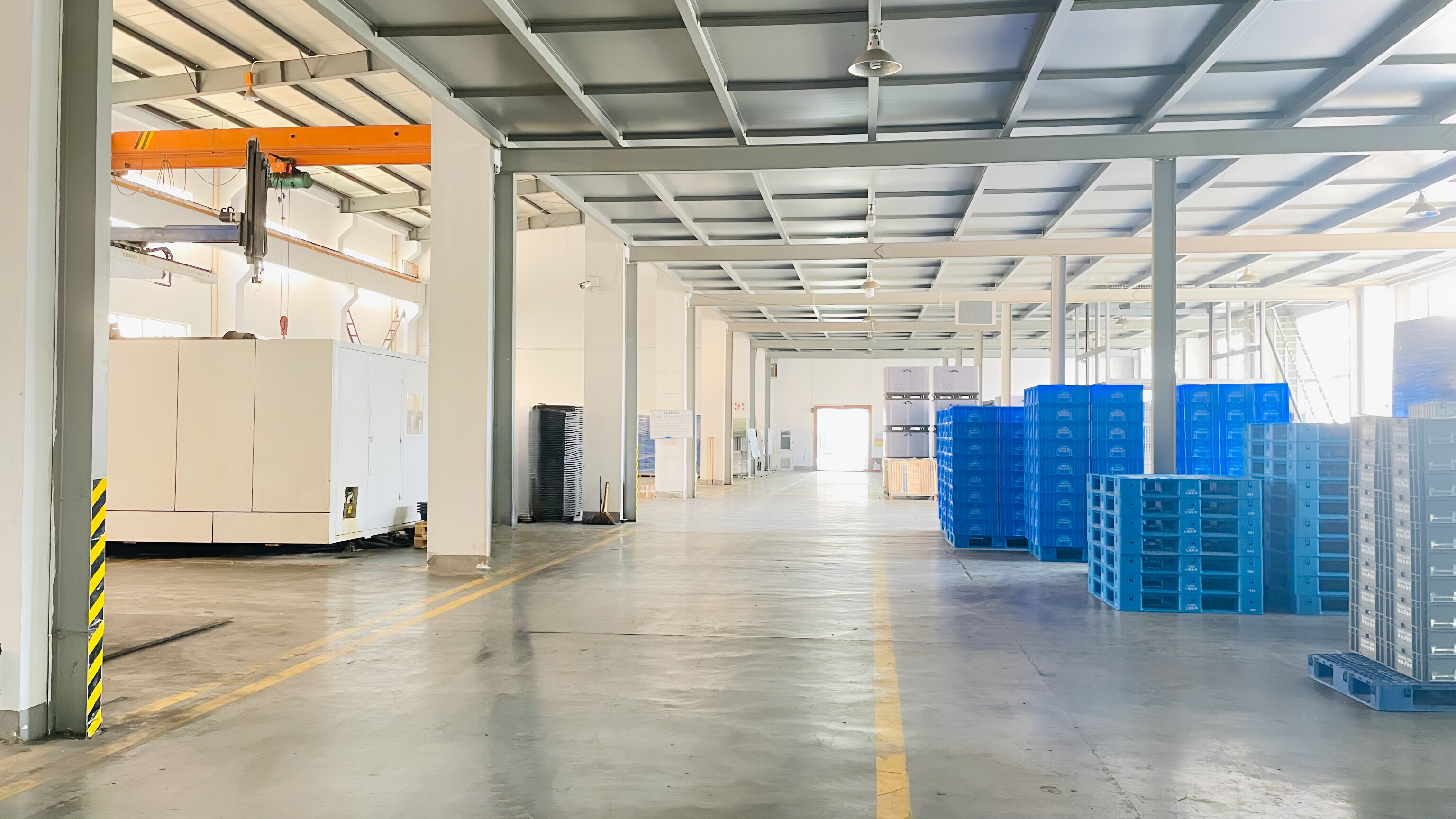
Manufacturing workshop: capacity claims are only useful to a buyer when the production floor behind them can be inspected.
Step-by-Step: Specifying a Pallet Box for a Project
The sequence below reflects the order in which the decisions actually constrain each other. Changing an early step later forces the specification back to the beginning, so it is worth following in order.
- Map the load. Record part dimensions, weight, the number of parts per box, and the handling equipment used — forklift and warehouse shelving are the most common combination in the projects described above.
- Define the environment. Note humidity, dust, temperature range, whether the area is washed down, and whether the site operates continuously. A waterproof and anti-static requirement, as seen in the Mexican warehousing project, belongs at this step, not at the end.
- Choose the construction. Use a molded enclosed box when containment, dust exclusion or ESD control is the priority. Use a honeycomb panel box when large footprints, heavy parts or folded returns dominate.
- Confirm material and containment. Select HDPE or PP, and confirm the substance list — oil, industrial alcohol, alkali, acid, industrial wastewater or water — against the intended grade and contact conditions.
- Specify the inner lining. Select a vacuum-formed, blister or anti-static blister lining so that part position and protection repeat across every box in the fleet.
- Validate with a sample. Test the erected box, the folded or nested configuration and the loaded part in the real handling loop before committing to a fleet size.
- Lock the commercial terms. Confirm size, color, logo, packing, lead time, delivery terms and the applicable HS classification before the purchase order is issued.
Use Cases: Where Enclosed Pallet Boxes Replace Cages
Medical and health care
Medical supply and equipment movement needs a closed, washable, dust-resistant interior. The molded enclosed box provides the sealed body, while a vacuum-formed inner lining keeps instruments or device components in fixed positions during transport.
Heavy industry
Foundries, machine shops and metalworking sites combine heavy loads, oil residue and humidity. The enclosed box holds the part and contains the residue, which is where an open cage stops being adequate.
Home logistics
Home and consumer logistics projects value consistent footprint, stacking stability and nestable empty handling. The same box that protects the goods on the outbound leg collapses or nests on the return leg.
Automotive and precision electronics
Powertrain and transmission parts use die-cast honeycomb board boxes with shaped linings, as in the three-year Mexico gearbox project. Precision electronics projects use anti-static blister linings inside an enclosed body for ESD-controlled storage and transport.
Comparison Table: Plastic Pallet Box vs. Steel Cage vs. Wire Mesh Cage
The comparison below is drawn from TOYOE product facts for the plastic column. Steel and wire cage behaviour is described in general engineering terms only, without supplier-specific figures, because cage specifications vary enormously by manufacturer and duty.
| Decision dimension | Plastic pallet box (HDPE/PP) | Steel cage | Wire mesh cage |
|---|---|---|---|
| Enclosure | Enclosed body with lid arrangement | Open frame with solid or mesh sides | Open mesh on all faces |
| Liquid and waste retention | Specified for oil, industrial alcohol, alkali, acid, industrial wastewater and water | Typically not designed to retain liquid | Typically not designed to retain liquid |
| Humidity and corrosion | HDPE/PP does not corrode; suited to damp and washed environments | Coating typically needs periodic inspection in humid service | Typically prone to corrosion at contact points |
| Part surface protection | Smooth molded interior; vacuum-formed or blister lining added to fit the part | Contact at frame members; lining usually added separately | Mesh contact points can mark finished surfaces |
| Empty return handling | Nestable; folding formats reach fold ratios up to 5:1 and cut empty volume by up to 75% | Typically rigid and non-nesting | Typically rigid; nesting depends on frame design |
| ESD-controlled interior | Anti-static blister inner lining tray available | Depends on coating specification | Depends on coating specification |
| Customization | Dimension, logo, color and material on an OEM/ODM basis | Usually dimension only | Usually dimension only |
| End-of-life material route | Recyclable HDPE/PP | Scrap metal recycling | Scrap metal recycling |
| Best-fit duty | Containment, liquids, waste, automotive parts, ESD interiors | Very heavy static loads where liquid retention is not required | Light, dry goods tolerant of contact marking |
FAQ
Do plastic pallet boxes need to meet any ESD or packaging compliance standards?
For electronics applications, yes. ANSI/ESD S541-2019 is the primary industry standard for packaging used to store, transport and protect electrostatic discharge susceptible items during production and distribution, and ESD-safe conductive polymer blends are commonly specified with surface resistance in the 10⁴–10¹⁰ Ω range. TOYOE supplies an anti-static blister tray as an inner lining option for projects that need an ESD-controlled interior. Buyers should confirm the required resistance band with their own ESD coordinator before ordering, and confirm the customs classification for cross-border shipments, which for plastic boxes and crates is HS 3923100000.
Can a plastic pallet box be custom-sized, and can it include a custom inner lining?
Yes. TOYOE works on an OEM/ODM basis and customizes dimension, logo, color and material, with multiple specifications available and full size customization on accepted custom orders. Reference sizes in the range include 1200×800×1000 mm, 1000×800×800 mm and 1230×830×1000 mm. Inner lining options include booster vacuum-formed linings, heavy-duty vacuum-formed linings, transmission blister linings and anti-static blister linings, all shaped to the part so that positioning repeats across the fleet.
What drives the cost of a pallet box project?
Five factors dominate. First, material selection between HDPE and PP. Second, box size and construction, since a one-piece molded enclosed body and a folding honeycomb panel sleeve are engineered differently. Third, inner lining complexity, because vacuum-formed and blister linings are tooled to the part. Fourth, whether an anti-static lining is required. Fifth, the return-logistics decision, where fold ratios of up to 5:1 and up to 75% empty-volume reduction lower the number of boxes and trucks a closed loop needs. Because these factors interact, a project-level quotation against a defined specification is more useful than a single list price.
Are samples available before a bulk order?
Yes. Samples are accepted, and the minimum order quantity for the range is one unit, so a single configured box can be produced for physical testing before a fleet commitment. Boxes are supplied with plastic film packing. Testing an assembled box, a folded or nested configuration and a loaded part in the real handling loop is the fastest way to confirm that the size, lining and stacking behaviour match the project.
What is the production lead time and what after-sales cover is provided?
The stated production lead time is 7–15 days, supported by an annual output of 30,000 units and a monthly capacity of around 3,000 pieces, with a 50% test regime in quality control. After-sales cover is a five-year guarantee that excludes damage caused by human error or by storing weight beyond the product's rated capacity. To move a project forward, send the part drawing, the medium or waste list and the target box size to the TOYOE team at zjgfh@zjgfenghui.cn or via WhatsApp on 86-19901499028, and request a sample and quotation against that specification.
Conclusion: Matching the Box to the Project, Not to the Habit
A plastic pallet box earns its place in a project when the job requires containment, moisture and dust protection, protection of finished surfaces, or repeated empty returns. Where those conditions are absent, a steel or wire cage remains a legitimate choice — the comparison is a project question, not a materials argument.
The practical sequence is short. Decide whether the load is wet or dry. Choose between a molded enclosed box and a honeycomb panel box. Fix the material and confirm chemical compatibility. Shape the interior with the right lining, including an anti-static option where electronics are involved. Then validate a single sample before scaling. Foldable and nestable designs, fold ratios up to 5:1, HDPE and PP recyclability, and inner-lining capability are the levers that decide whether the fleet keeps circulating or quietly grows.
Start with a Sample, Then Scale the Fleet
TOYOE builds plastic pallet boxes, honeycomb panel boxes and plastic crates on an OEM/ODM basis for automotive, heavy industry, medical, home logistics and precision electronics projects. Custom dimensions, colors, logos and inner linings are supported, with a minimum order quantity of one unit and a 7–15 day lead time.
Request a sample and quotation, or download the full product brochure: TOYOE Pallet Box Brochure (PDF)
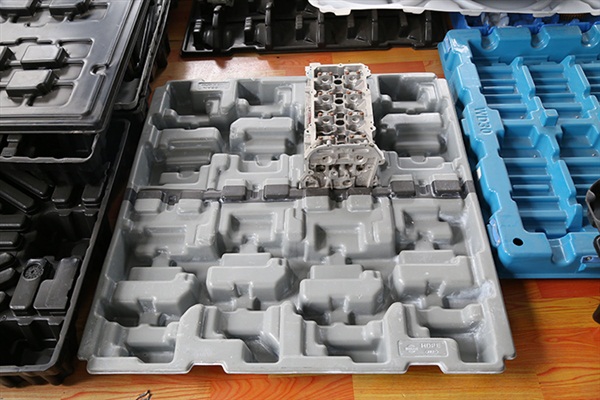
A heavy-duty vacuum-formed inner lining tray: the sample stage is where part fit, lining choice and stacking behaviour are confirmed together.
About the manufacturer: Zhangjiagang Fenghui Logistics Equipment Co., Ltd. (TOYOE) was founded in June 2010 and is based at No. 5 Donghuan Road, Zhaofeng Leyu Town, Zhangjiagang, 215600, Suzhou, Jiangsu, China. The company manufactures plastic pallet boxes, storage boxes, plastic crates and honeycomb panel boxes, with a 4,000 m² factory, 34 employees, two R&D engineers and an annual output of 30,000 units. Website: www.toyoebox.com | Email: zjgfh@zjgfenghui.cn | Tel: 86-15370396661 | WhatsApp: 86-19901499028
Have Questions or Need More Details?
Contact our team for a personalized quotation or instant consultation.
Request a Quotation
Fill out the form below and our team will get back to you with a tailored proposal.
WhatsApp Direct Chat
Prefer to chat in real-time? Message us on WhatsApp for instant assistance & quick answers.
- Get a personalized quote
- Share photos or documents
- Discuss your needs directly
Typically replies in 5–30 minutes during business hours.