Pallet Box Compliance Guide: HS Code 3923100000, Regional Requirements, and Material Specs
A plastic pallet box shipped from Suzhou, China is classified under HS code 3923100000, and the customs file behind that number is built from four verifiable inputs: the six-digit HS heading for plastic boxes, cases and crates; the importing country's national tariff extension; a material declaration naming HDPE or PP; and a country-of-origin statement. This guide sets out those inputs, the model specifications that support them, and the supplier documentation that evaluation-stage and execution-stage buyers should collect before the first container is booked.
Why Pallet Box Compliance Typically Breaks Down Before Shipment
Most pallet box compliance problems are created in an office, not at a port. The product is rarely the issue; the paperwork is. When a plastic pallet box leaves Suzhou for the European Union, Southeast Asia, Mexico or the United States, the customs file has to answer four questions the same way in every document: what the article is, what it is made of, where it came from, and what quality evidence supports the order.
Four failure points repeat across industrial packaging shipments:
- Classification drift. The manufacturer's specification sheet states HS Code 3923100000, but the importer files a broader or narrower national tariff line because the invoice description was simplified to "plastic container" instead of "pallet box".
- Material ambiguity. "Plastic" is not a material declaration. The material stated for this product family is HDPE or PP, and regional files should name the polymer rather than the category.
- Origin inconsistency. Origin appears as Suzhou, China in one document and as a different location in another. Customs authorities compare documents, so mismatches create questions even when the goods are correct.
- Certificate claims without evidence. "ISO certified" with no certificate number, issuing body, scope or validity date cannot be used in supplier qualification, and it tempts buyers to write unverified statements into a declaration.
The commercial cost of these gaps is predictable: inspection holds, storage charges, duty reassessment and revised delivery dates that the buyer's own customer has already been promised. In an execution-stage procurement, those costs land on the buyer's schedule, not the supplier's.
The practical fix is to build the compliance file during evaluation, using facts the manufacturer can document in writing, and then reuse the same wording from quotation through to the bill of lading.
Industry Background: What HS 3923100000 Covers
In the Harmonized System, heading 3923 covers articles for the conveyance or packing of goods, of plastics, and subheading 3923.10 covers boxes, cases, crates and similar articles. HS codes are maintained at six digits internationally, and each country extends them with its own digits for duty and statistical purposes. That is why the specification data for this product family shows HS Code 3923100000 with Suzhou, China as the place of origin: the first six digits are the international classification, and the national extension is added at the exporting end.
The trade context explains why this classification is well understood by most brokers. China is the dominant exporter of HS 392310 products, with an export value of USD 2.33 billion in 2022, based on UN Comtrade data republished by FreightAmigo. A supply chain rooted in the Suzhou manufacturing cluster is therefore working inside a mature, well-documented export category, where the real risk is inconsistency rather than obscurity.
Demand context is worth reading carefully. One commercial research report values the global pallet box market at USD 2.19 billion in 2024. Published valuations differ between sources because scope definitions differ, with some reports counting pallet boxes alone and others counting plastic containers, crates and bulk bins together. Buyers should treat any single market figure as directional context, not as a purchasing benchmark.
Return logistics is the part of the compliance picture that buyers often overlook. Nestable and folding designs change how many units can be repositioned in a return container, and category research reports fold ratios reaching 5:1, cutting empty volume by up to 75%. Those figures matter commercially because container counts feed directly into the shipping documentation a buyer has to prepare.
What a Defensible Pallet Box Compliance File Contains
A defensible file is boring by design: the same product nouns, the same polymer designation, the same origin statement and the same certificate numbers appear in every document. The sections below describe what can be documented for this product family, and how each item should be used.
1. Product identity and the classification block
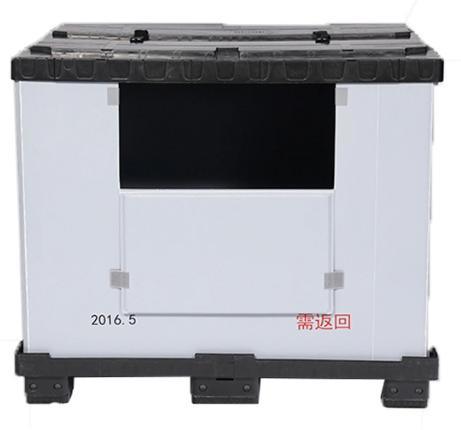
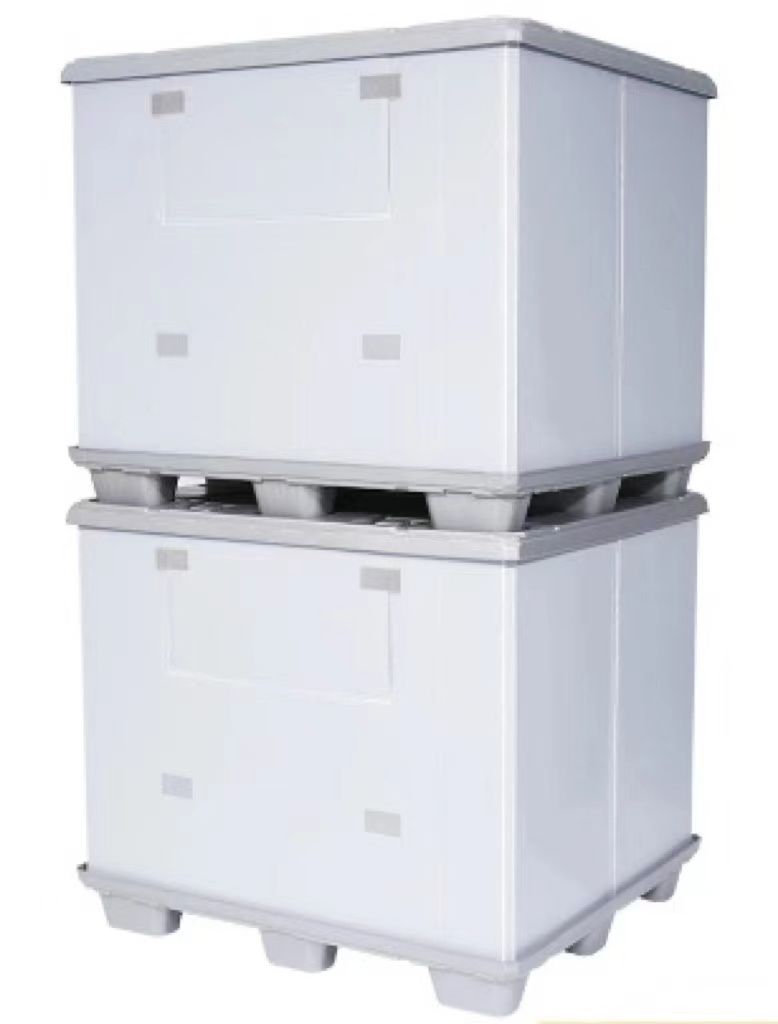
TOYOE-branded pallet boxes are manufactured by Zhangjiagang Fenghui Logistics Equipment Co., Ltd., a company founded in June 2010 and based in Zhangjiagang, Suzhou, Jiangsu, China. The specification data behind the 1200*800*1000 Plastic Pallet Box lists HS Code 3923100000, Origin Suzhou, China, Type Enclosed, Material HDPE/PP, Capacity 100–200 L, Packing plastic film, and the features Recyclable, Durable and Nestable. The applications listed for the same product family are oil, industrial alcohol, alkali, acid, industrial wastewater, water and car parts.
Buyer action: use the model designation and its size string exactly as the manufacturer states them, then repeat those nouns in the quotation, proforma invoice, commercial invoice, packing list and bill of lading. Classification disputes usually begin with a description that was simplified somewhere in the chain and never corrected.
2. Material and design specifications that support the declaration
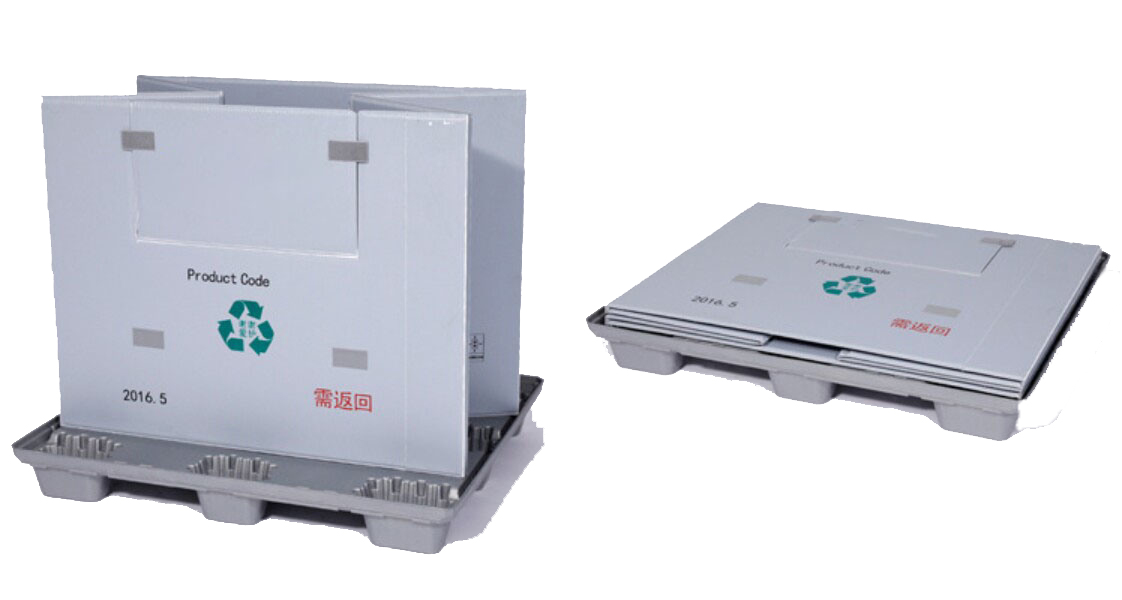
HDPE and PP both support a recyclability statement, which is why the declaration should name the polymer rather than say "plastic". Recyclable, durable and nestable are the stated features of the standard model; size is customized, and dimension, logo, color and material can all be customized under the manufacturer's OEM/ODM service.
Nestable design is a compliance-adjacent benefit rather than a marketing point. Fewer empty containers for the same volume of returned units means fewer lines in return-shipment documentation and lower repositioning cost. Across the wider category, folding designs are reported with fold ratios up to 5:1 and empty-volume reductions of up to 75% in commercial research, which is useful evidence when a buyer has to justify container counts internally.
One caution belongs here. The application list — oil, industrial alcohol, alkali, acid, industrial wastewater, water, car parts — is the manufacturer's statement of intended use for an enclosed industrial pallet box. It is not a chemical-resistance rating and not a destination-specific approval for regulated substances. Buyers shipping regulated liquids should request material-compatibility documentation for their specific contents before filing.
3. Manufacturer facts that belong in the supplier file
A buyer preparing a customs file is also qualifying a supplier, and the two tasks share the same facts. Zhangjiagang Fenghui Logistics Equipment Co., Ltd. operates a 4,000 m² factory with 34 employees and 2 R&D engineers, and reports an annual output of 30,000 units with a monthly capacity of 3,000 pieces. Its stated export ratio is 40%, and its main markets are Mexico and the United States, with the EU and Southeast Asia listed as export markets for its custom production service.
Commercial terms are part of the same picture: production mode OEM/ODM, minimum order quantity 1 unit, lead time 7–15 days, delivery terms FOB and CIF, and payment terms of 30% deposit in advance with the 70% balance before shipment. Capacity, lead time and market mix tell a buyer whether the documentation pack will be produced on schedule, and whether the supplier already ships into the destination region involved.
4. Certificate documentation: what to collect and how to read it
Two management-system certificates are documented for this manufacturer and can be attached to a supplier file:
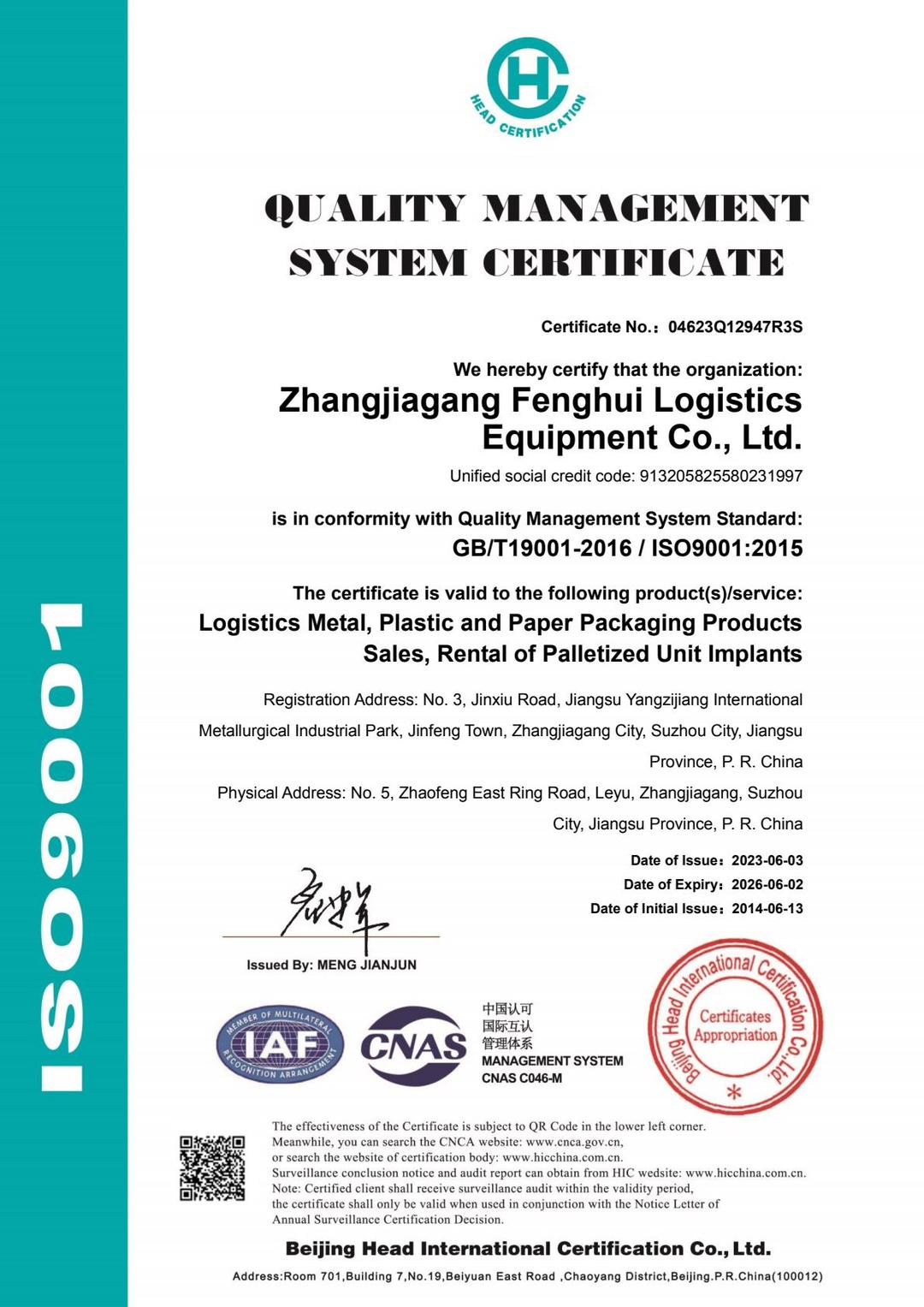
- ISO 9001 — certificate number 04623Q12947R3S, issued under GB/T19001-2016 / ISO 9001:2015 by Beijing Head International Certification Co., Ltd. (IAF/CNAS accredited). Scope: sales of logistics metal, plastic and paper packaging products; rental of palletized unit loads.
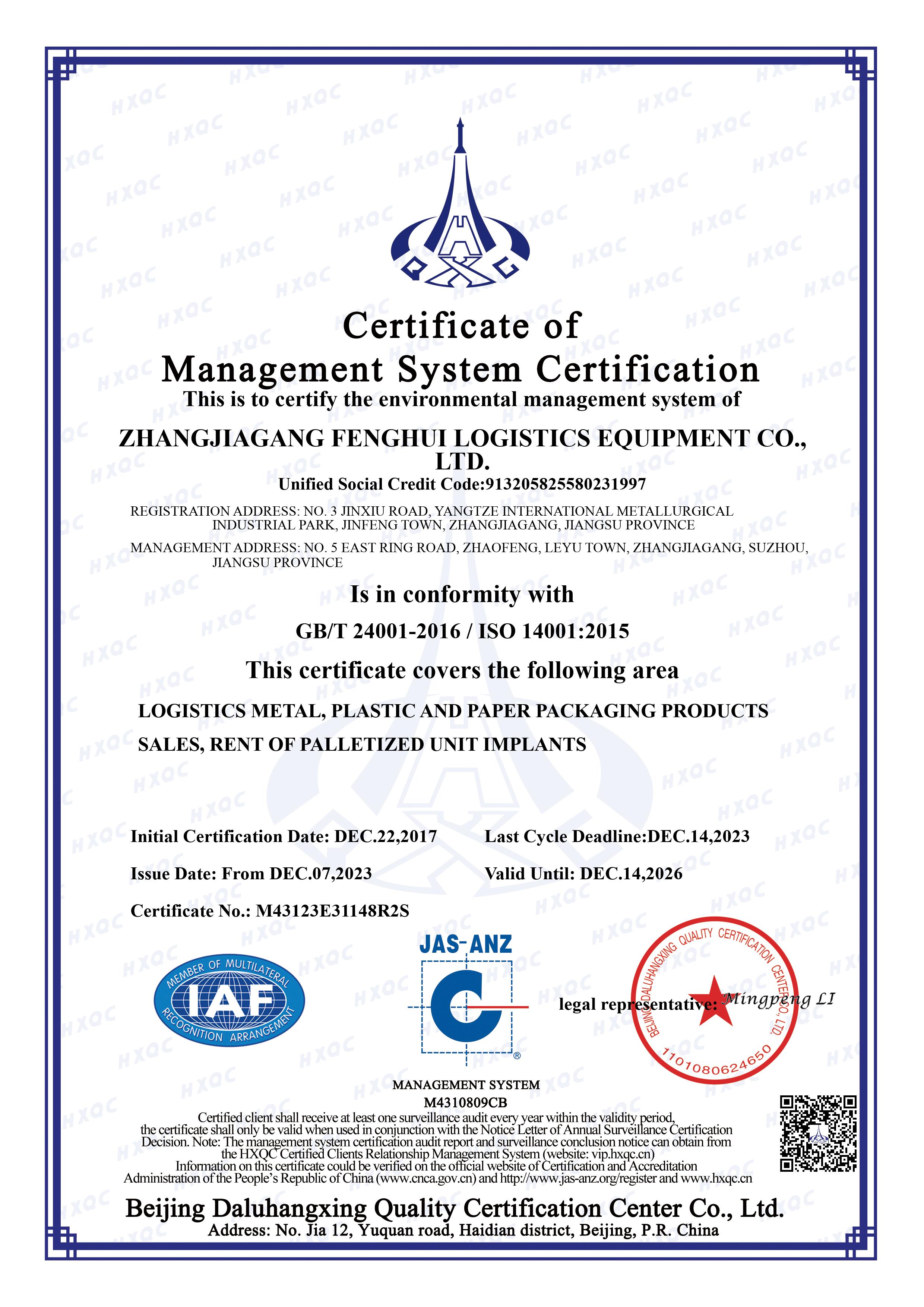
- ISO 14001 — certificate number M43123E31148R2S, issued under ISO 14001:2015 by Beijing Daluhangxing Quality Certification Center Co., Ltd., valid to 14 December 2026. Scope: logistics metal, plastic and paper packaging products sales, rent of palletized unit implants.
Read them for what they are. Both are management-system certificates covering a sales scope, not product-specific conformity marks for a particular destination market. Certificate validity periods are fixed, so buyers should confirm current status on the issuing body's register at the time of ordering rather than relying on a copy received months earlier.
5. Quality-control evidence
The manufacturer states a 50% product testing rate. Before mass production, sample testing is carried out for confirmation and test reports are obtained for the raw materials, so acceptance criteria are defined before volume output rather than after it. That sequence is what makes the file defensible: the test documentation exists before the commercial invoice does.
After-sales coverage is stated as a 5-year guarantee, excluding damage caused by human error or by excessive storage weight of the product. The exclusion is not a formality. It defines the buyer's obligation to keep loads within the working limits agreed for the model, and it belongs in the buyer's own handling instruction, not only in the supplier's terms.
6. Static-control documentation for electronics-adjacent cargo
Where a pallet box is used to move ESD-susceptible parts, ANSI/ESD S541-2019 is the reference standard for packaging used to store, transport and protect those items. ESD-safe conductive polymer blends are commonly specified with surface resistance between 10⁴ and 10¹⁰ Ω. Buyers sourcing an ESD pallet box should request a surface-resistance test report rather than accept the word "anti-static" on a quotation, because the term alone carries no measurable value.
Mapping the File to EU, Southeast Asia, Mexico and U.S. Shipments
The six-digit heading travels; the national extension does not. Every destination applies its own tariff line and its own importer-side practice, so the reliable method is to ask the importer or customs broker which fields are required and then supply them from one consistent product file.
- European Union. Importers typically want the polymer named and the recyclability position stated clearly, with consignee details matching the invoice. National packaging and waste rules differ between member states, so confirm the applicable rule at the specific point of entry rather than assuming one EU-wide treatment.
- Southeast Asia. This region is listed among the manufacturer's export markets for custom work. Confirm the local tariff line and any material declaration format with the importer, since national extensions differ from the six-digit heading the supplier quotes.
- Mexico. One of the manufacturer's two main markets, with a documented automotive project in service. Where the importer's file needs a Spanish-language description, keep the same product nouns used on the invoice and packing list instead of re-describing the box in different terms.
- United States. Also a main market for the manufacturer. The origin statement must match the invoice and packing list exactly, and for electronics content the packaging specification should reference the ESD standard above.
Step-by-Step: Preparing a Pallet Box Order for Clearance
Where These Pallet Boxes Are Used
Automotive parts storage in Mexico
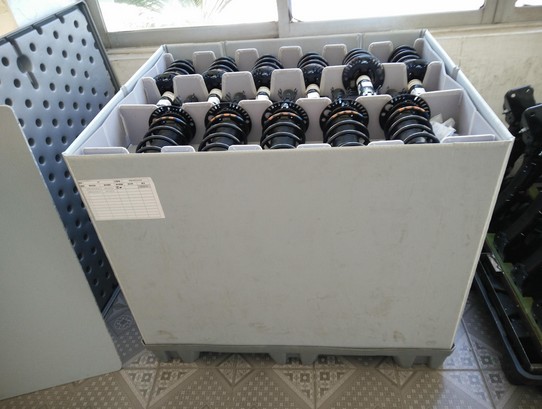
A documented project supplies 1,000 pieces to an automobile manufacturer in Mexico for storing car transmission gearboxes. The boxes have been in use for three years, and the project addressed the problem of collision damage to gearboxes during storage, achieving standardized storage of auto parts and improved warehouse management efficiency. The stated highlights of the solution are high load-bearing capacity, shock resistance, a stable structure, and a fit to the dimensions of an automatic transmission gearbox.
For buyers replicating that model, the relevant specification options are the 1200*800*1000 Plastic Pallet Box and the 1230*830*1000 die-cast pallet box used for automotive engines, both within the same enclosed pallet box family.
Fluids, chemicals and industrial process storage
The stated application list covers oil, industrial alcohol, alkali, acid, industrial wastewater and water, which places the product in enclosed, heavy-load industrial storage rather than general warehousing. Buyers in this segment should pair the material declaration with content-specific compatibility documentation, because the polymer designation alone does not certify resistance to a particular substance at a particular concentration.
Export and return logistics
With a stated export ratio of 40% and EU and Southeast Asia listed as export markets for custom production, these boxes are frequently designed around return flows rather than one-way shipment. Nestable and space-saving configurations reduce the number of containers required for empties, which changes both freight cost and the volume of documentation a buyer prepares for returned units.
Electronics and precision parts
Where parts are static-sensitive, the compliance conversation shifts from tariff classification to packaging specification. A pallet box presented for ESD applications should be supported by a surface-resistance test report against ANSI/ESD S541-2019 and by a stated resistance range, typically between 10⁴ and 10¹⁰ Ω for conductive polymer blends.
Model Comparison: Four Pallet Box Configurations
The four models below come from the same specification set. Features (recyclable, durable, nestable), origin (Suzhou, China), packing (plastic film), customization options (size, color, logo, material) and the application list are stated identically for all four; the practical difference is size and board construction.
| Model (as specified) | Construction type | Size (as specified) | Material | Capacity | HS code |
|---|---|---|---|---|---|
| Plastic Pallet Box | Enclosed storage box — plastic pallet box — plastic honeycomb panel box | 1200*800*1000 | PP, HDPE | 100–200 L | 3923100000 |
| Plastic Honeycomb Panel Box | Enclosed storage box — blow-molded honeycomb board box | 1000*800*800 | HDPE, PP | 100–200 L | 3923100000 |
| Storage Pallet Box | Enclosed storage box — plastic pallet box | 1000*800*800 | HDPE | 100–200 L | 3923100000 |
| Die-cast pallet box for automotive engines | Enclosed storage box — die-cast honeycomb board box | 1230*830*1000 | HDPE | 100–200 L | 3923100000 |
All four carry the same HS code, which is useful when a buyer orders a mixed pallet of sizes: the classification block does not change, but the model designation and size string must still be listed line by line on the invoice and packing list.
FAQ: Pallet Box Compliance and Sourcing Questions
What HS code and origin should appear on our pallet box shipping documents?
HS code 3923100000 with Suzhou, China as the place of origin is what the manufacturer's specification data states for this plastic pallet box family. In the Harmonized System, heading 3923 covers articles for the conveyance or packing of goods, of plastics, and subheading 3923.10 covers boxes, cases, crates and similar articles. The six-digit heading is international, but each country adds its own national extension, so the tariff line filed at destination should be confirmed with your importer or customs broker. The supporting fields are the product description, the polymer designation (HDPE or PP) and the origin statement, kept identical across invoice, packing list and bill of lading.
Can the manufacturer customize pallet boxes for a specific product, line or region?
Yes. The manufacturer provides OEM and ODM production services, and the customization scope covers dimension, logo, color and material. Capacity is documented at 3,000 pieces per month within an annual output of 30,000 units, produced in a 4,000 m² factory with 34 employees and 2 R&D engineers. Model options include the 1200*800*1000 plastic pallet box, the 1230*830*1000 die-cast pallet box for automotive engines, and 1000*800*800 storage and honeycomb panel boxes, all with customized size, color and free logo printing available.
What are the purchasing and payment terms?
The minimum order quantity is 1 unit, which allows a single-box evaluation before volume commitment. Delivery terms are FOB and CIF, and payment terms are 30% deposit in advance with the 70% balance before shipment. Production lead time is 7–15 days and should be planned together with the shipping schedule rather than quoted to a downstream customer as total delivery time.
How is quality validated before mass production?
Sample orders are accepted, and before mass production the manufacturer conducts sample testing for confirmation and obtains test reports for the raw materials. The stated routine quality-control rate is 50% product testing. After-sales coverage is stated as a 5-year guarantee, excluding cases of damage due to human error or excessive storage weight of the product — which is why working load limits should be written into the buyer's handling instruction.
What lead time and after-sales support should we plan for?
Lead time is 7–15 days for production, with a 5-year after-sales guarantee covering the product under the stated exclusions. For buyers preparing a first order, the fastest way to close the remaining compliance questions is to send the destination country and the model size under evaluation, so the documentation pack — specification sheet, test-report summary, certificate copies and the current catalog — can be assembled against that specific market.
Conclusion: Compliance Is a Documentation Habit
The product facts for this pallet box family are stable and repeatable: HS code 3923100000, origin Suzhou, China, HDPE or PP material, 100–200 L capacity, recyclable and nestable enclosed design, custom sizes and colors, a 7–15 day production lead time, a 50% product testing rate and a 5-year after-sales guarantee with defined exclusions. None of that is complicated. What fails is the consistency of how those facts are written.
Buyers preparing orders for the EU, Southeast Asia, Mexico or the United States should build the file once — classification, material, origin, certificates and test evidence — and then reuse the same wording through quotation, invoice, packing list and bill of lading. Where destination-specific rules apply, your importer or customs broker remains the authority on the tariff line and the declaration format.
Reviewed against the same discipline, the certificate documentation, the quality-control record and the model specifications become what they are meant to be: procurement evidence, not advertising claims.
Prepare Your Order File with TOYOE
TOYOE pallet boxes are manufactured by Zhangjiagang Fenghui Logistics Equipment Co., Ltd. in Zhangjiagang, Suzhou, Jiangsu, China. Request the specification sheet, sample evaluation or a project quotation for your destination market.
Product catalog (PDF): download the TOYOE brochure
Website: www.toyoebox.com
Email: zjgfh@zjgfenghui.cn | WhatsApp: 86-19901499028
Contact: Jack Zha | Address: No. 5 Donghuan Road, Zhaofeng, Leyu Town, Zhangjiagang, 215600, Suzhou, Jiangsu, China
Have Questions or Need More Details?
Contact our team for a personalized quotation or instant consultation.
Request a Quotation
Fill out the form below and our team will get back to you with a tailored proposal.
WhatsApp Direct Chat
Prefer to chat in real-time? Message us on WhatsApp for instant assistance & quick answers.
- Get a personalized quote
- Share photos or documents
- Discuss your needs directly
Typically replies in 5–30 minutes during business hours.