30,000 Sets Per Year: How to Validate a Pallet Box Manufacturer's True Delivery Capacity
A 30,000-set annual capacity claim tells you the ceiling a supplier claims for one product family over twelve months. It does not tell you whether your order will ship on time. Delivery is decided by what sits underneath that ceiling: floor space, headcount, quality gates, and how much of the line is already committed. This guide gives industrial buyers a working audit rubric for converting a capacity number into verifiable evidence, using a disclosed profile — 4,000 m² of factory space, 34 staff, an asserted monthly capacity of 3,000 pieces, and a stated lead time of 7–15 days — as the reference case.
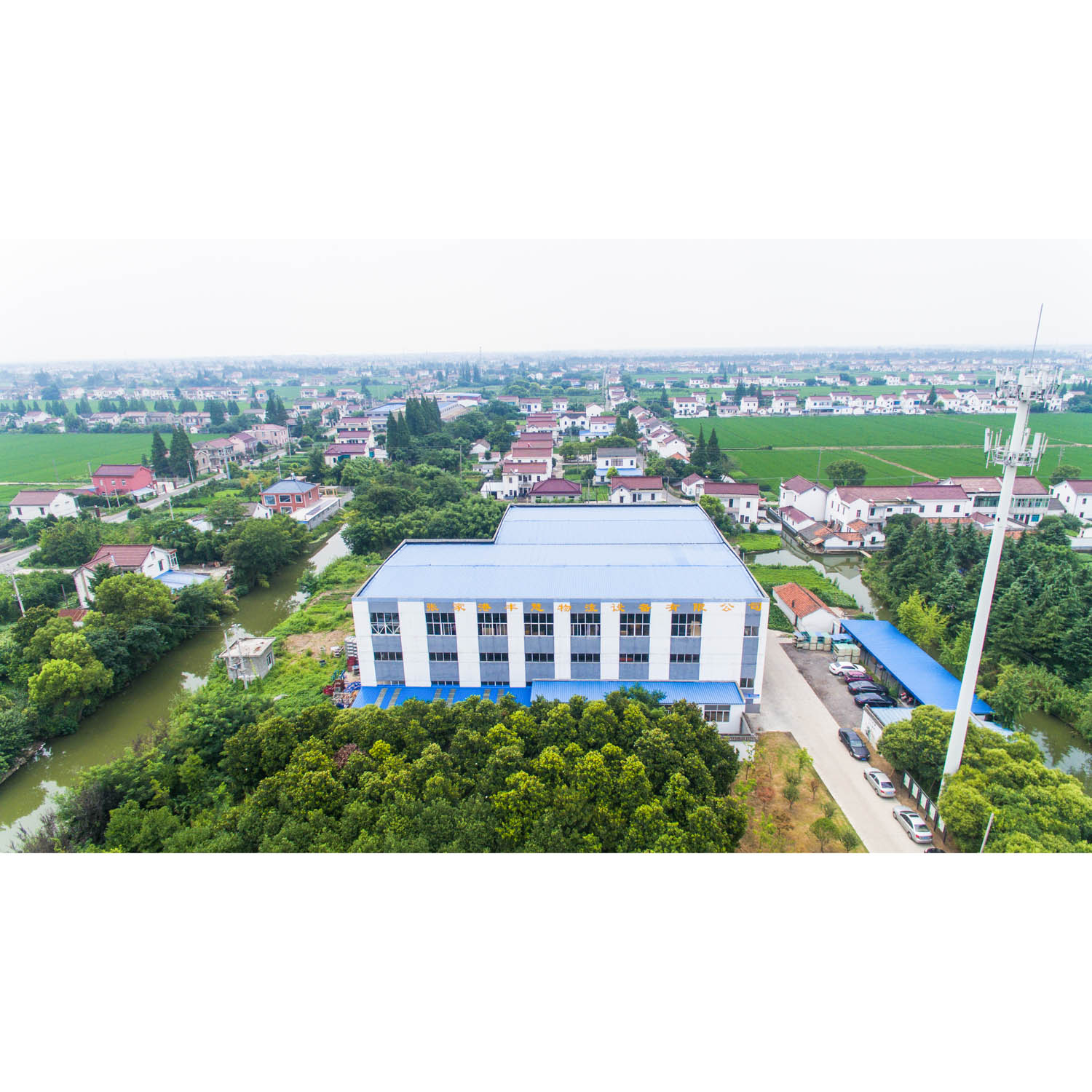
The reference profile belongs to Zhangjiagang Fenghui Logistics Equipment Co., Ltd., which manufactures under the brand TOYOE. The company was founded in June 2010, is based in Zhangjiagang, Suzhou, Jiangsu, China, and produces plastic pallet boxes, storage boxes, plastic crates and honeycomb panel boxes. Every figure quoted in this article comes from that company's published product and capability records or from named third-party sources; where a number cannot be verified, the rubric says so instead of estimating it.
What a 30,000-set capacity claim actually measures
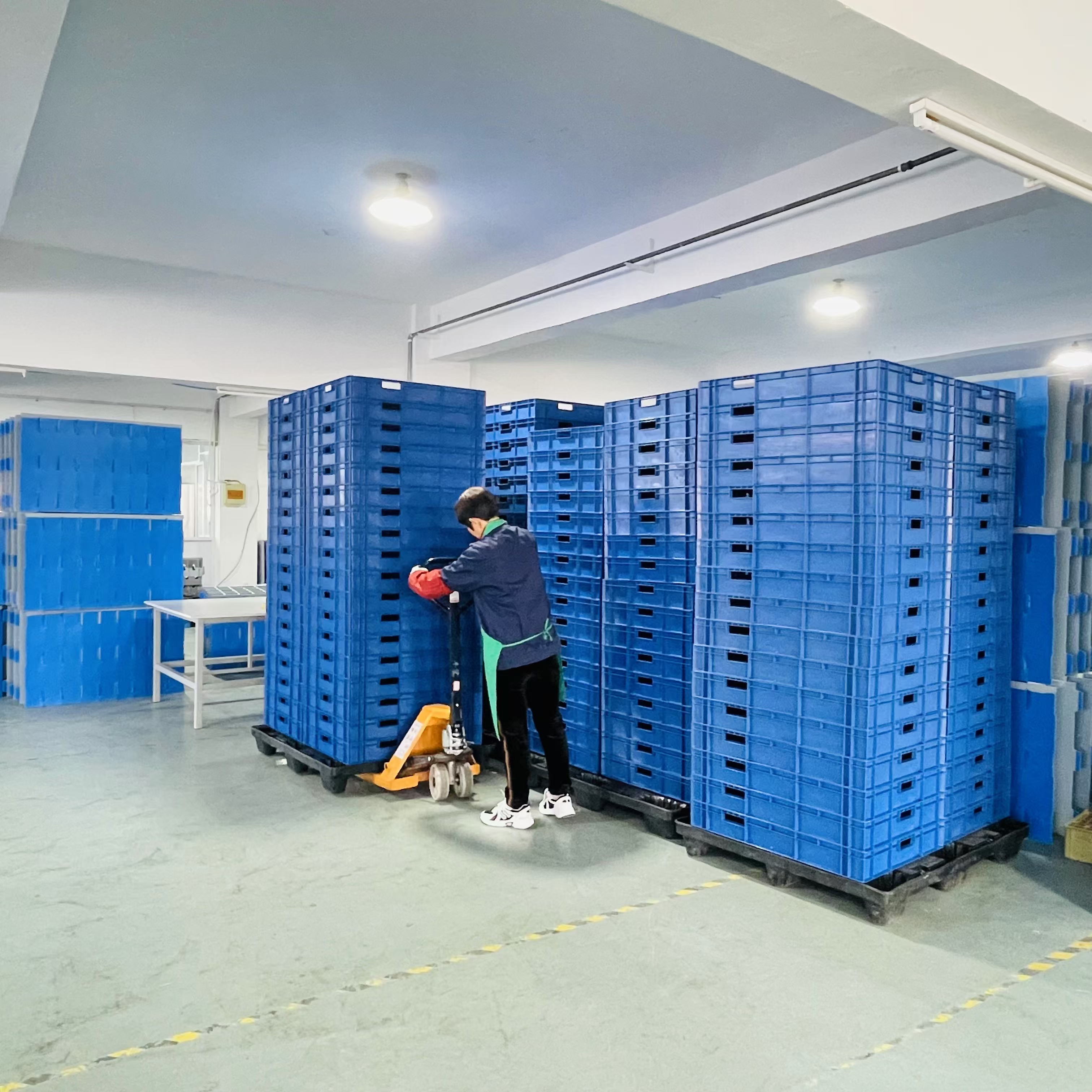
A capacity figure is a scope statement before it is a number. When a supplier states 30,000 sets per year, four things decide whether that figure applies to your purchase order:
- Product scope. Which SKUs count toward the 30,000? A die-cast honeycomb board box in 1230×830×1000 and a standard 1200×800×1000 plastic pallet box consume different machine time and different labour.
- Time basis. Annual output assumes a full twelve months at planned rate. Monthly capacity describes a peak month. The two are rarely identical.
- Committed volume. Capacity is what the plant can produce; availability is what remains after existing contracts. A supplier can report 30,000 units/year honestly and still have no free slot next month.
- Customisation load. Custom dimensions, custom colours, printed logos and fitted inner linings all pass through engineering review before they pass through the line. That review capacity is finite.
The same discipline applies to published market data, and the pallet box category demonstrates why. Two research sources covering the global pallet box market report the same base year, 2024, at USD 2.19 billion and USD 12.76 billion respectively. The difference is a definition difference — one source isolates pallet boxes, the other aggregates crates and large bulk containers — not a measurement error. A buyer who accepts either number without asking what is inside it will misread the market exactly the way they would misread a supplier's capacity figure.
Working rule: before you compare any two capacity claims, force both into the same units, the same product scope, and the same time period. A claim that cannot survive that conversion is a marketing statement, not a planning input.
Why capacity claims are hard to verify in the pallet box market
The pallet box supply base is geographically concentrated, which changes what a capacity claim is worth. China is the dominant exporter of goods classified under HS 392310, with an export value of USD 2.33 billion in 2022 according to UN Comtrade-based trade data. Concentration in manufacturing clusters such as the Suzhou and Jiangsu region means buyers can reach a deep supplier pool quickly — and that many suppliers publish similar-sounding capacity statements. Differentiation therefore has to come from audit evidence rather than from the size of the number on a quotation.
Public benchmarking data will not close the gap for you. A structured review of verified data for this category concluded that competitor capacity benchmarking — annual revenue and production volume for the largest global industrial pallet box suppliers — was not available from public, traceable sources. Without an industry league table to compare against, the practical method is direct verification against the supplier's own declared parameters. That is what the rest of this article sets out to do.
One structural distinction matters more than any other before the audit begins: is the company you are talking to a manufacturer or a trading intermediary? A trading company can quote 30,000 units a year without owning a moulding line. A manufacturer carries the footprint, the headcount and the quality gate. The audit rubric below is designed to surface that difference through questions a trading intermediary cannot answer with documents alone.
The four evidence pillars behind a real capacity number
1. Factory footprint: what 4,000 m² has to contain
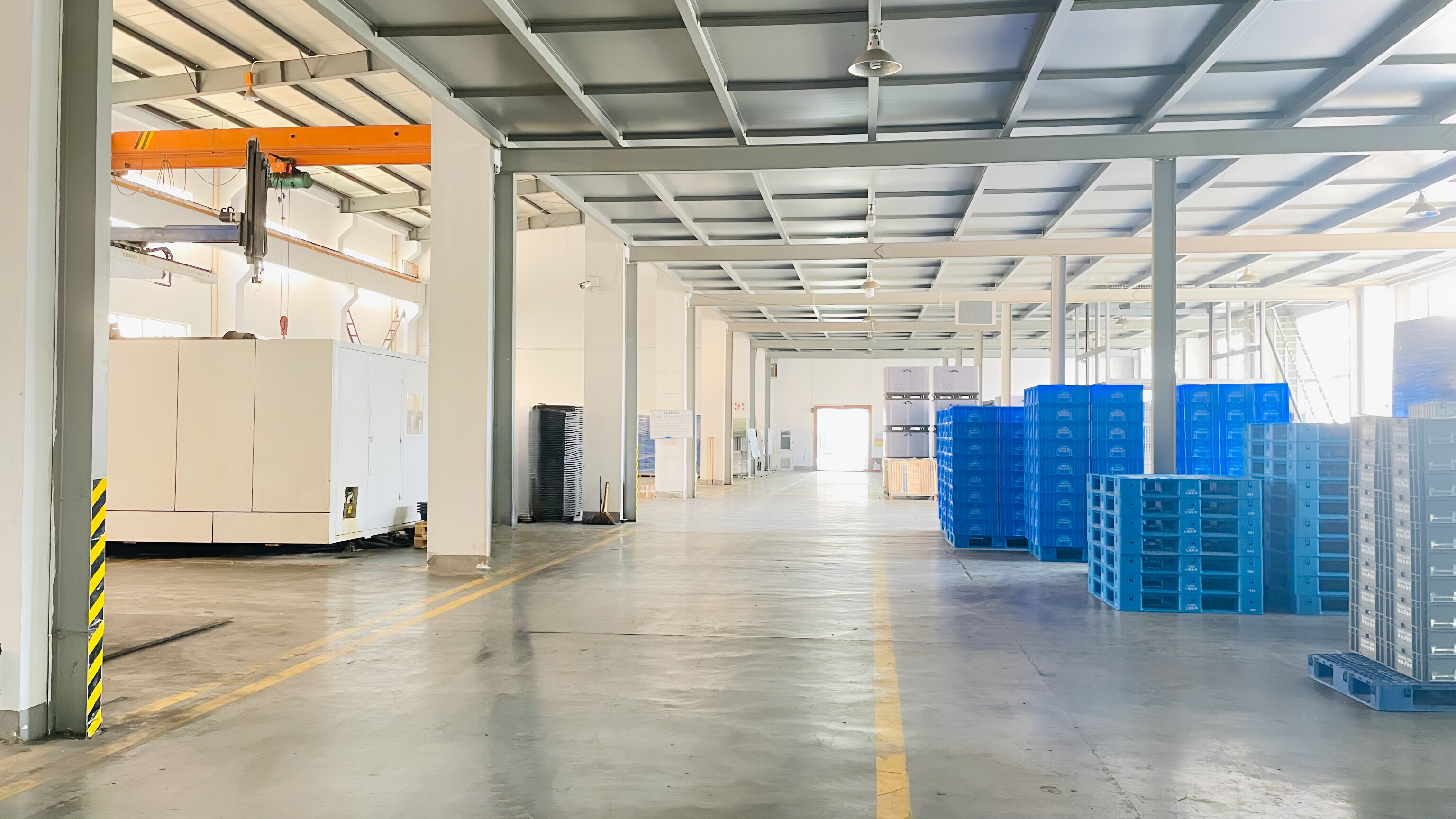
A declared factory area of 4,000 m² is only meaningful once you know how it is divided. A pallet box operation has to fit raw material storage for HDPE and PP, moulding or panel production, assembly, quality inspection, and finished goods staging — all inside the same walls. Ask for the proportion of production floor to warehouse floor. If finished goods staging is thin, output is throttled by dispatch rather than by production, and your lead time will stretch whenever the shipping calendar tightens.
2. Team depth: 34 staff and 2 engineers
Headcount is the pillar buyers skip, and it is the one that explains delivery performance. A disclosed team of 34 employees supporting an annual output of 30,000 units works out to roughly 880 units per person per year — an arithmetic check you can run on any supplier's numbers before you visit. Two engineers in the R&D function is the more revealing figure for custom work: every non-standard dimension, colour, logo and inner lining passes through that small group, so the number of concurrent custom projects the supplier can absorb is bounded by engineering review capacity, not by machine time.
3. Quality gates: what a 50% test rate covers
A quality control regime described as 50% test means half of production passes through the inspection gate. That is a defensible number provided you ask two follow-up questions: which characteristics are tested, and at which stage. Dimensional accuracy, load-bearing behaviour and stacking stability are tested differently, and a 50% rate applied only to final visual inspection is not the same gate as a 50% rate applied to structural or electrical performance.
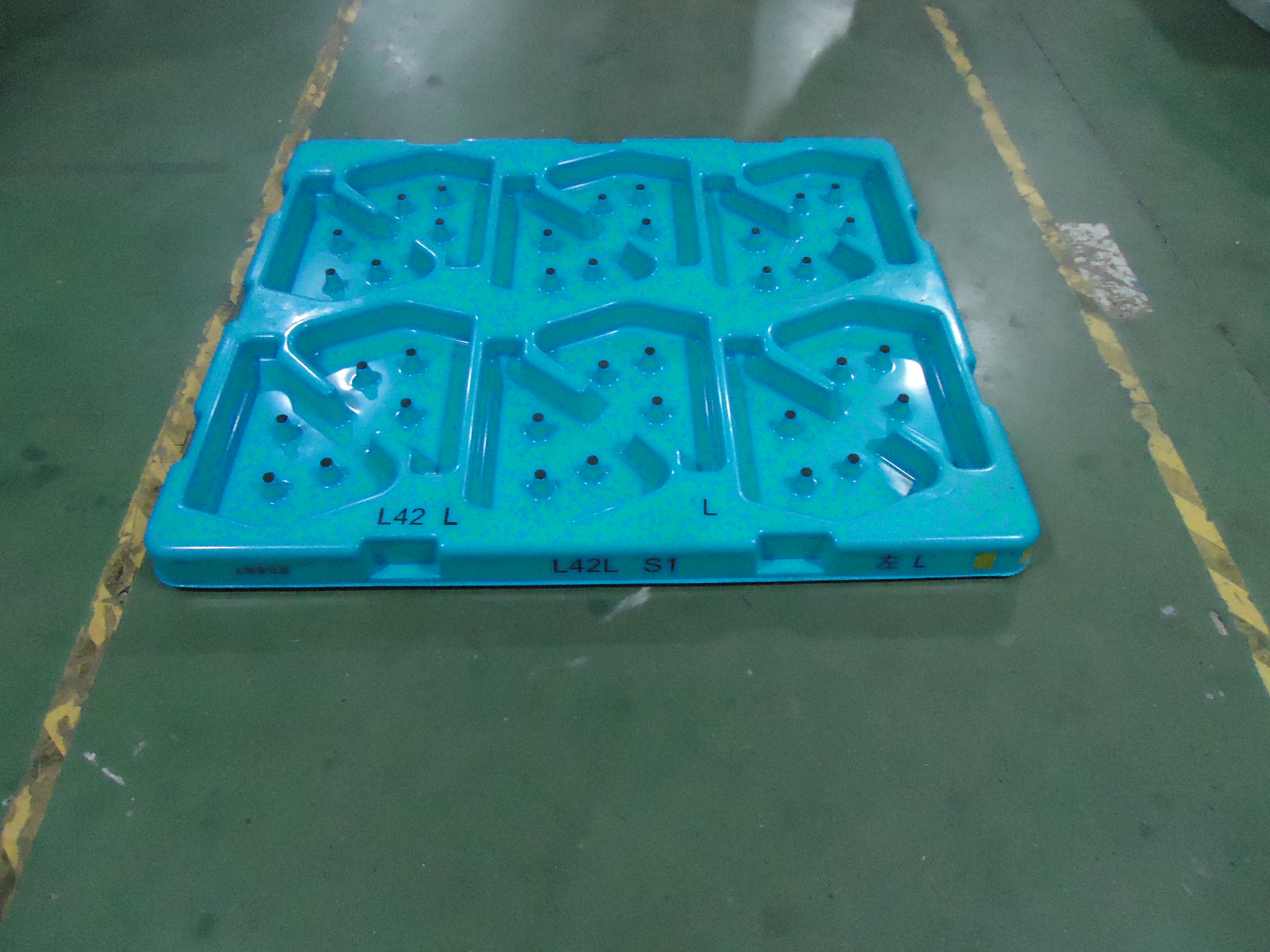
For ESD pallet boxes, the gate changes shape entirely. Packaging used to store, transport and protect electrostatic-discharge-susceptible items falls under ANSI/ESD S541-2019, and conductive polymer blends are specified with a surface resistance within 10⁴–10¹⁰ Ω. If your order is an ESD pallet box, ask how the test rate accounts for surface resistance measurement, not simply for appearance.
4. Throughput maths: reconciling 3,000 pieces per month with 30,000 sets per year
This is the fastest verification available to any buyer, and it requires nothing but a calculator. A monthly capacity of 3,000 pieces multiplied by twelve months gives a nominal annual ceiling of 36,000 units. Against a declared annual output of 30,000 units, that implies an average utilisation of roughly 83% of the monthly ceiling — a buffer of about 17% that is consistent with a plant holding maintenance downtime and changeover time.
Capacity arithmetic on the disclosed profile: 3,000 pieces × 12 months = 36,000 units nominal annual ceiling. Declared annual output = 30,000 units. Implied average utilisation ≈ 83%. Stated production lead time = 7–15 days. The numbers reconcile, but only at a utilisation level below full load — which is exactly the assumption you should test against the supplier's peak-month history.
If a supplier's monthly and annual figures imply utilisation above 100%, the two numbers were not derived from the same plant. If they imply a very low figure, ask why the capacity exists but is not used.
A seven-step buyer audit rubric
- Convert every claim into units and days. Take annual output, monthly capacity and lead time, and express them in one unit of measure. On the reference profile: 30,000 units/year, 3,000 pieces/month, 7–15 days. Any claim that cannot be converted stays on the "unverified" list.
- Request the footprint plan and walk the split. Confirm the declared 4,000 m² and identify how much is production floor versus raw material and finished goods storage. Photograph the finished goods area rather than the reception area.
- Map headcount to process steps. Ask for 34 staff broken down by function — moulding, panel production, assembly, inspection, packing, engineering. Confirm who staffs the second shift and who covers absence.
- Audit the quality gate and the certification record. Establish what the 50% test rate covers and at which stage. Then verify certificates at the issuing body, not in the sales deck — check the certificate number, the standard, the scope line and the validity window.
- Benchmark your custom order against the monthly line. Custom orders consume engineering review from a two-engineer team. Ask how many concurrent custom projects the plant is running, and what happens to standard lead time when that queue fills.
- Test the 7–15 day claim with a trial order. Issue a small, fully specified order — a single unit is accepted as a sample order on the reference profile — and measure the actual dispatch date against the stated window under normal conditions.
- Lock the commercial terms that affect delivery risk. Confirm the guarantee scope, packing method and customs classification so that the delivery date you audited is the delivery date you can plan around.
What to verify on the certification record
Certificates are the cheapest evidence a supplier can show and the easiest to misread. Read the field values, not the badge.
| Field | ISO 9001 record | ISO 14001 record |
|---|---|---|
| Standard | GB/T19001-2016 / ISO9001:2015 | ISO 14001:2015 |
| Certificate number | 04623Q12947R3S | M43123E31148R2S |
| Issuing body | Beijing Head International Certification Co., Ltd. (IAF/CNAS accredited) | Beijing Daluhangxing Quality Certification Center Co., Ltd. |
| Coverage | Applicable to the global market | Applicable to the global market |
| Scope line to read carefully | Sales of logistics metal, plastic and paper packaging products; rental of palletized unit loads | LOGISTICS METAL, PLASTIC AND PAPER PACKAGING PRODUCTS SALES, RENT OF PALLETIZED UNIT IMPLANTS |
| Buyer action | Confirm scope, number and current validity with the issuing body | Confirm scope, number and current validity with the issuing body |
Both certificates relate to the pallet box product (product code 3905). The scope wording describes sales and rental of logistics packaging, which is why a buyer evaluating a capacity claim should treat certification as one pillar of the audit and not as a substitute for the factory walk-through.
How the rubric applies to real programmes
Automotive transmission storage — a 1,000-piece programme
An automobile manufacturer in Mexico ordered 1,000 pieces to store car transmission gearboxes, with three years of continuous operation behind it. The working conditions were demanding: 24/7 operation, high humidity, dust, a wide temperature range, forklift handling, stacking and storage, with moisture-proof, shock-resistant and load-stable performance required. Capacity validation for this programme did not depend on the annual headline figure. It depended on how the 1,000 units were phased against the monthly ceiling and whether the 4,000 m² footprint could stage 1,000 finished units without blocking the next production run.
ESD components and precision electronics
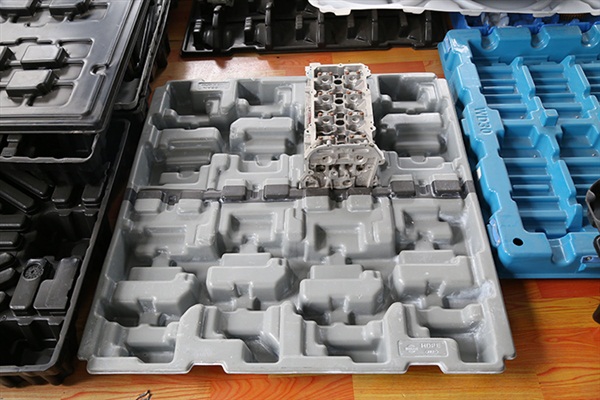
Where the pallet box carries ESD-susceptible parts, the delivery question shifts from "how many units per month" to "how many tested units per month". Surface resistance specified within 10⁴–10¹⁰ Ω and compliance with ANSI/ESD S541-2019 packaging practice both consume inspection time. A 50% test rate that includes electrical verification is a materially different production constraint from a 50% visual test rate, and it should be priced and scheduled as such.
Heavy and die-cast component handling
Die-cast pallet boxes and high-load-bearing configurations — including the 1230×830×1000 die-cast honeycomb board box used for automotive engines — sit at the top of the load spectrum. These units are slower to produce and slower to test. If your programme consumes a large share of the monthly line, the utilisation buffer derived in step four is your best early warning that a lead time will slip.
Export programmes into the United States and Mexico
Roughly 40% of this manufacturer's output is exported, with Mexico and the United States as the main markets. For export buyers, delivery capacity has a second dimension: packing and documentation. Product is packed in plastic film and classified under HS code 3923100000, which is the code your customs broker will use for landed-cost planning. A capacity audit that stops at the factory gate is incomplete if the classification and packing method are not confirmed in the same review.
Capacity claim vs. verification evidence
| Declared figure | What it actually asserts | Evidence that closes the gap |
|---|---|---|
| 4,000 m² factory | Physical space available for production and storage | Floor plan plus a walked split between production floor, raw material and finished goods |
| 34 employees, 2 engineers | Labour depth and engineering review capacity | Function-by-function headcount list and shift coverage confirmation |
| 3,000 pieces monthly capacity | Peak monthly output ceiling | Peak-month and average-month output record, plus changeover assumptions |
| 30,000 units annual output | Committed twelve-month volume at planned utilisation | Reconciliation against the monthly ceiling; implied utilisation of about 83% |
| 7–15 days lead time | Normal-condition elapsed time from order to dispatch | A trial order measured against the stated window, with day one defined |
| 50% test rate | Inspection throughput at the quality gate | The list of tested characteristics and the production stage at which testing occurs |
| MOQ 1 unit | Minimum order quantity, sample accepted | A single-unit sample order used as a live lead-time test |
| 5-year guarantee | After-sales coverage excluding human-error damage and excessive storage weight | Written load assumptions attached to the order, so the exclusion has a defined boundary |
| Custom order accepted | Dimension, logo, colour and material customisation | Drawing approval and a physical sample of the inner lining or box geometry |
| ISO 9001 and ISO 14001 | Certified management systems under named issuing bodies | Certificate number, scope line and current validity confirmed with the issuer |
Frequently asked questions
Which certifications and standards should I verify before accepting a capacity claim?
The pallet box product (product code 3905) holds ISO 9001 certification under standard GB/T19001-2016 / ISO9001:2015, certificate number 04623Q12947R3S, issued by Beijing Head International Certification Co., Ltd., an IAF/CNAS accredited body, applicable to the global market. The same product also holds ISO 14001:2015 certification, certificate number M43123E31148R2S, issued by Beijing Daluhangxing Quality Certification Center Co., Ltd., applicable globally. Verify three things directly with the issuing bodies: the certificate number, the scope wording — both records describe sales and rental of logistics packaging — and the current validity window. If your order is an ESD pallet box, add the packaging standard rather than the management standard: ANSI/ESD S541-2019 applies to packaging for ESD-susceptible items, with conductive polymer blends specified within 10⁴–10¹⁰ Ω surface resistance.
How do I benchmark a supplier's monthly capacity against my custom pallet box order?
Convert everything to one period first. On the reference profile, 3,000 pieces per month against a declared 30,000 units per year implies an average utilisation of roughly 83% of the monthly ceiling — a buffer consistent with downtime and changeover. Then subtract committed volume and check your share of the remainder. Custom work is the constraint most buyers underestimate: a two-engineer R&D team handles dimension, colour, logo and material changes for every non-standard order, so the practical limit on concurrent custom projects is engineering review throughput, not machine time. Ask how many custom projects are live and what the queue looks like before you accept a lead time.
How does a capacity claim affect the cost position I should plan for?
Capacity risk is a cost line rather than a price list. Where a claim cannot be reconciled against monthly output, buyers typically absorb the difference through expedited freight, buffer stock or a second qualified source — all of which add cost after the order is placed. Practical cost levers you can confirm without negotiating price are the quality gate, the tooling route for purchased components, and the trial mechanism: a minimum order quantity of 1 unit with samples accepted lets you validate a specification and an actual despatch date before committing volume. That converts an unverified capacity claim into a measured one at the lowest possible cost.
Can a custom pallet box be validated with a sample before mass production?
Yes. Samples are accepted on the reference profile, custom orders are accepted, and the minimum order quantity is 1 unit. Customisation covers dimension, logo, colour and material. Use the sample for more than appearance: measure the assembled dimensions against the drawing, load it to your stated working weight, confirm the inner lining geometry if the order uses a vacuum-formed or blister tray, and record how many days the sample took from confirmation to despatch. Note that the five-year guarantee excludes damage from human error and from excessive storage weight, so the load assumptions you test with should be documented and attached to the order.
Is a 7–15 day lead time realistic, and how do I test it?
The stated production lead time on this profile is 7–15 days, against an annual capacity of 30,000 units and a monthly capacity of 3,000 pieces. Whether the window applies to your order depends on three conditions you should fix in writing: which event starts the clock (purchase order receipt or drawing approval), whether your order falls inside the 50% test gate en route, and how the order is phased against existing commitments. The cleanest test is a single-unit sample order placed under normal conditions and timed from the agreed start event to despatch. If you want to run that test, request a pallet box sample with your drawing or working dimensions and we will quote against the specification you provide.
Conclusion: audit the number, then commit the volume
A 30,000-set annual capacity claim survives scrutiny when four pieces of evidence line up: a footprint you have walked, a headcount you have mapped to process steps, a quality gate with a defined test rate, and arithmetic that reconciles monthly capacity with annual output. On the reference profile those four checks produce a coherent picture — 4,000 m² of factory space, 34 employees including 2 engineers, 3,000 pieces per month against 30,000 units per year, a 50% test rate, and a stated 7–15 day lead time. The claim is credible precisely because it can be checked, not because it is large. For buyers in Research and Evaluation, that distinction is the difference between a supplier you can plan around and one you have to re-qualify mid-project.
The corollary is that you should never audit capacity without auditing the surrounding terms at the same time. Certification scope, packing method, customs classification and guarantee boundaries all determine whether the delivery date you verified is the delivery date you can rely on. Run the seven steps, keep the arithmetic, and define day one of the lead time in the purchase order.
Next step: test the claim with one unit
If you are evaluating plastic pallet box capacity for an automotive, electronics or heavy-industry programme, the fastest way to verify the 7–15 day window is a single-unit sample order against your own dimensions. Minimum order quantity is 1 unit, custom sizes, colours, logos and materials are accepted, and product is packed in plastic film under HS code 3923100000.
Send your drawing or working dimensions to zjgfh@zjgfenghui.cn, message Jack Zha on WhatsApp at +86 199 0149 9028, or review the full capability and specification set first in the TOYOE product catalogue (PDF). Company details: Zhangjiagang Fenghui Logistics Equipment Co., Ltd., No. 5 Donghuan Road, Zhaofeng, Leyu Town, Zhangjiagang, 215600, Suzhou, Jiangsu, China — www.toyoebox.com.
Have Questions or Need More Details?
Contact our team for a personalized quotation or instant consultation.
Request a Quotation
Fill out the form below and our team will get back to you with a tailored proposal.
WhatsApp Direct Chat
Prefer to chat in real-time? Message us on WhatsApp for instant assistance & quick answers.
- Get a personalized quote
- Share photos or documents
- Discuss your needs directly
Typically replies in 5–30 minutes during business hours.