Retrofitting Automotive Gearbox Lines with Nestable Storage Pallet Boxes
Retrofitting an automotive gearbox line usually starts as a fixture or conveyor project and ends as a storage and handling project. A transmission leaves the assembly line once, but it is picked up, stacked, racked, unstacked, loaded and unloaded many times before it reaches the customer. Each of those movements is an opportunity for collision damage, and the pallet box is the component that decides how much of that risk the line actually carries.
This guide is written for plant and logistics engineers, warehouse planners and procurement teams specifying packaging for gearbox and transmission storage. It addresses the three requirements that dominate a gearbox retrofit: a standardized stacking pattern that does not depend on operator judgement, transport protection for machined and assembled units, and a 1200 × 800 mm base footprint that fits the racking and handling equipment already installed.
In short: a nestable plastic pallet box on a 1200 × 800 mm base, fitted with a customized inner lining sized to the transmission envelope, delivers standardized stacking, controlled point loading and a defined protection layer — moisture-proof and, where required, anti-static — and can be nested, folded or dismantled for the return trip when empty.
Problem Definition: Why Gearbox Storage Damages Parts Before Shipment
Gearbox storage damage is not random. It clusters around three failure modes that logistics packaging risk assessments classify as collision, moisture damage and overload. Each one has a known control method: shockproof packaging, moisture-proof protection and load limit control.
Collision is the failure mode that most often triggers a retrofit. Transmissions held in loose or under-sized containers move during placement and retrieval, collide with the container wall and with neighbouring units, and the damage is frequently discovered later — at final inspection or at the customer's goods-in check. The control method documented for this failure mode is shockproof packaging combined with load limit control: a solid box structure that limits horizontal movement, internal protection that absorbs contact, and a maximum stack height that is inspected rather than assumed. Overload is treated the same way, through a defined load limit verified by strict load inspection instead of a judgement call made by whoever is stacking the box.
Moisture is the second failure mode and the one most often overlooked on gearbox lines, because the parts are metal. A sealed moisture-proof design protects machined surfaces, bearings and any electronics during storage and across the sea-container leg. Where a line also stages static-sensitive components, anti-static material is added as a third protection layer.
What separates gearbox storage from general parts storage is density and consequence. A transmission is a heavy, high-value assembly with machined mating faces, and a single unit concentrates load on a small area of the box floor. A box specified only by external dimensions — without a load limit, an internal position fixture or a defined stack pattern — leaves all three failure modes unmanaged, however solid the container looks in a catalogue photo.
Industry Background: Why the Retrofit Is Justified Now
Two structural shifts in logistics packaging make a gearbox line retrofit easier to justify today than a few years ago.
The first is the material shift from wood to plastic. Grand View Research projects the global plastic pallets and pallet box market to reach approximately USD 11.2 billion by 2030, driven by the move away from wood toward durable plastic solutions in logistics. Regional supply has moved with it: Straits Research reports that Asia Pacific accounted for over 32% of plastic pallet market revenue in 2023, with China leading in industrial production capacity — which is why a custom box programme sourced from a Chinese manufacturer is now a routine procurement path for European and North American automotive plants.
The second shift is construction-specific. Global Market Insights projects that the plastic honeycomb board packaging market will grow at a CAGR of 5.9% through 2032, largely because of its high strength-to-weight ratio for automotive parts transport — the same property that makes a honeycomb panel pallet box attractive when box weight has to come down without losing load-bearing capability.
Protection requirements are tightening in parallel. Research Nester expects the ESD packaging market, which includes trays and pallet boxes, to reach USD 5.89 billion by 2035, growing at a CAGR of 5.8%. For gearbox lines that stage electronic or static-sensitive subassemblies beside mechanical parts, a static-dissipative box is moving from optional extra to line-level requirement.
Standards give the retrofit a common reference point. EN 13626:2003 is the primary European standard specifying requirements and test methods for reusable box pallets used for material handling. For a retrofit tied to a European OEM programme, it is the natural baseline vocabulary for both the specification document and the incoming-goods conversation.
Detailed Solution: Specifying a Nestable Storage Pallet Box for Gearbox Lines
TOYOE is the logistics packaging brand of Zhangjiagang Fenghui Logistics Equipment Co., Ltd., a manufacturer of plastic pallet boxes, storage boxes, plastic crates and honeycomb panel boxes founded in 2010, whose main export markets are Mexico and the USA. The product families that matter in a gearbox retrofit are the nestable and folding pallet box, the custom-sized pallet box with customized inner lining, the honeycomb panel box and the plastic crate.
A 1200 × 800 mm base that fits the racking you already own
The most common reason a gearbox packaging project stalls is that the new box does not fit what the plant already has. Racking, pallet conveyors and forklift attachments on automotive sites are usually built around a 1200 × 800 mm base footprint. Specifying the box on that base keeps the retrofit inside the existing rack and handling envelope, so no beam, conveyor or attachment modification is required — and the same box moves from line-end staging to the warehouse rack to the truck without a footprint change.
Standardized stacking instead of operator judgement
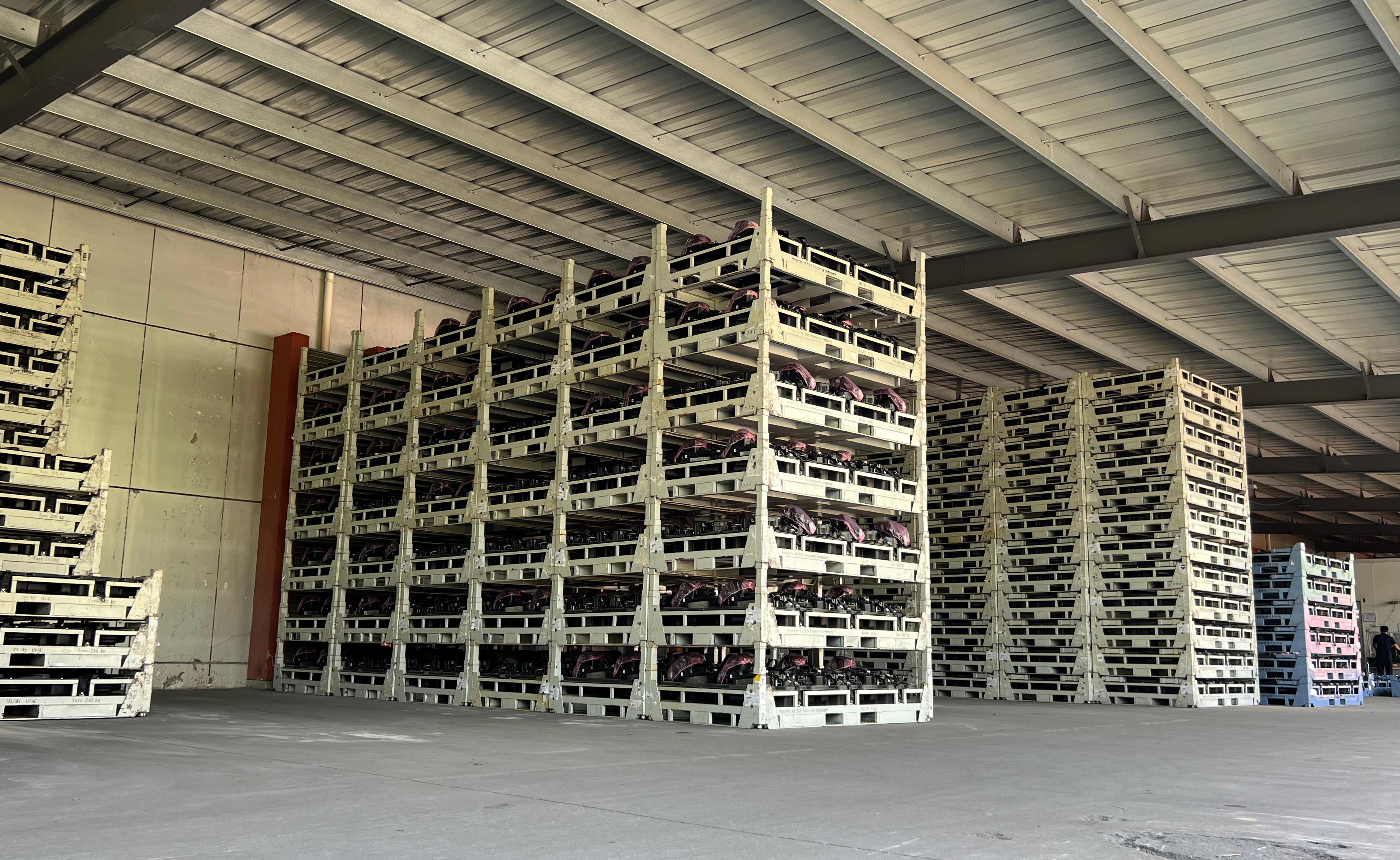
Standardized stacking means the stack is a documented pattern rather than a skill. A stackable pallet box repeats the same footprint at every level, each level is aligned over the one below, and an anti-slip top surface with a solid box structure keeps the pattern stable during placement and retrieval. Units per box, boxes per stack and maximum stack height are written into the specification and the work instruction, which turns stacking into a check against a limit rather than a decision made under time pressure.
No-tool inner fixtures sized to the transmission envelope
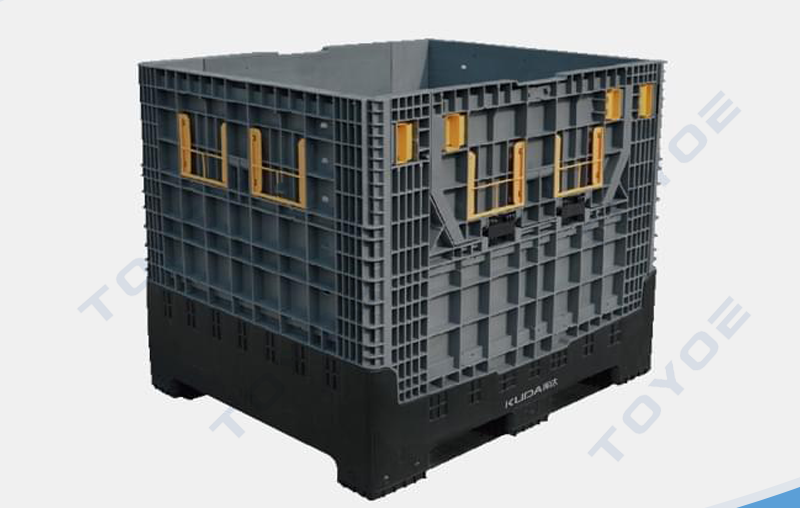
Gearbox lines rarely run a single variant, and a custom-sized pallet box with a customized inner lining is the practical answer. The liner is specified against the actual transmission dimensions — housing footprint, shaft length, mounting flange pattern — so the unit sits in a defined position instead of being packed loosely. Because the fixture is located by the box structure itself, no special tooling is needed on the line to fit, refit or change it, and a variant change becomes a liner change rather than a new box programme. That is what keeps a multi-variant line economical.
Protection specified in layers
Storage and transport protection is specified against the same three failure modes identified above: a sealed moisture-proof design against moisture, shockproof internal packaging and a solid box structure against collision, and a defined load limit verified by strict load inspection against overload. Where static-sensitive components are staged near the line, anti-static material is available in the same specification, producing an ESD pallet box that can travel the same route as the mechanical packaging.
Nesting, folding and demountable options for the return trip
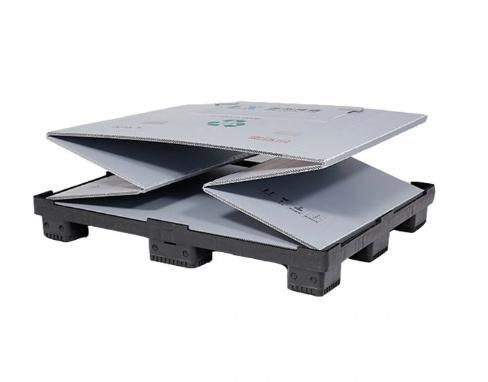
Gearbox packaging rarely travels one way. Once empty, a fixed box occupies almost the same volume as a full one, and return freight is where packaging programmes quietly lose their savings. Nestable, folding and demountable pallet box designs reduce empty volume so more empties fit into the same truck, and they make the box practical for line-side buffer areas where floor space is tight. The choice between fixed, nesting, folding and demountable depends on how far the empties travel and how often the box is reconfigured, so it belongs in the specification, not in a decision taken after the first shipment.
Construction choice: injection-moulded or honeycomb panel
Injection plastic pallet boxes provide a rigid, durable body for heavy-load-bearing storage and repeated handling. Plastic honeycomb board pallet boxes use a high strength-to-weight construction suited to automotive parts transport, where box weight and payload have to be balanced. Both are reusable, and both belong to the same family as the storage box and the plastic crate, which lets a plant standardize on one packaging source across gearbox storage and general parts handling.
Step-by-Step Breakdown of the Retrofit
- Audit the envelope and the route. Measure the largest and smallest gearbox variants, then walk the route from line-end to rack to truck and record every transfer point. The audit defines box footprint, stack height and protection level.
- Confirm the base footprint against the rack. Check rack beam spacing, pallet conveyor width and forklift attachments against the 1200 × 800 mm base before the box drawing is frozen — this single check removes racking modification from most projects.
- Set the stacking pattern and the load limit. Define units per box, boxes per stack and maximum stack weight, and write them into the work instruction so stacking and load inspection become checks against a documented limit.
- Specify the inner fixture against transmission dimensions. Issue the gearbox drawings together with the box specification, and confirm that the liner can be fitted and changed on the line without special tooling.
- Decide the return configuration. Choose fixed, nestable, folding or demountable based on empty-transport distance, available floor space and how often the fixture is reconfigured.
- Fix the protection level. Confirm sealed moisture-proof protection, shockproof internal packaging and — where static-sensitive components are present — anti-static material.
- Pilot, inspect, then freeze the standard. Run a pilot batch through the real route, review collision, moisture and overload observations against the documented control methods, then freeze the box and liner specification and manage it as a controlled document.
Use Cases Across a Gearbox Line
Line-end staging of assembled transmissions
At the end of the assembly line, the box holds transmissions between the last station and the buffer. The inner lining keeps each unit in a defined position, so units cannot collide with each other when a full box is moved or when a partly filled box is parked beside another.
Finished-goods buffer ahead of export
For plants shipping to Mexico and the USA, the box is also the export package: sealed against moisture for the container leg, stackable for container cube utilization, and compatible with the 1200 × 800 mm handling equipment used at both ends of the route.
Die-cast and machined housing transport
Die-cast housings and machined parts move on the same flows as finished transmissions. A die-cast pallet box configuration with a heavier load limit covers denser, more abrasive loads without forcing a second packaging standard onto the line.
Static-sensitive parts staged beside the line
Where electronic subassemblies or static-sensitive parts are staged in the same area, an anti-static version of the same box keeps one handling standard across the line instead of splitting mechanical and electronic packaging flows.
Comparison Table: Wooden Pallet Versus Plastic Pallet Box
| Decision criterion | Wooden pallet | Plastic pallet box (TOYOE) |
|---|---|---|
| Up-front purchase cost | Lower initial cost | 30% higher initial cost |
| Total cost over long-term use | Higher total cost over time | 45% lower total cost in long-term use |
| Service life | Baseline | Service life extended by 3–5 times |
| Maintenance workload | Baseline | 80% less maintenance work |
| Moisture behaviour | Moisture-sensitive | Moisture-proof, with better moisture resistance |
| Pest and mildew damage | Possible | No pest and mildew damage |
| Load behaviour in storage | Variable | Stable bearing capacity and stable load capacity |
| Best-fit scenarios | General one-way handling | Food, pharmaceutical, warehousing and export logistics scenarios |
FAQ: Gearbox Storage Pallet Box Decisions
What standard applies to reusable plastic pallet boxes for material handling?
EN 13626:2003 is the primary European standard specifying requirements and test methods for reusable box pallets used for material handling. It is the sensible baseline reference when a gearbox retrofit is tied to a European OEM programme. Before the specification is frozen, confirm which test methods and load figures the receiving plant requires, since the standard defines the test framework rather than a single universal box.
Can a pallet box be fitted to specific gearbox or transmission dimensions without special tooling?
Yes. A custom-sized pallet box with a customized inner lining is specified against the actual transmission dimensions, so each unit sits in a defined position inside the box. The fixture is located by the box structure itself, which means it can be fitted, refitted or changed without special tooling on the line. On multi-variant gearbox lines, a variant change therefore becomes a liner change instead of a new box programme.
Will a pallet box for gearbox storage fit existing warehouse racking?
It will, if the box is specified on a 1200 × 800 mm base footprint. Automotive racking, pallet conveyors and forklift attachments are generally built around that base, so keeping the box on it allows existing rack beams and handling equipment to be used unchanged. Measure the actual beam spacing and required stack height on site before the box drawing is frozen, and confirm the stack pattern fits the clear height under the beams.
How does a plastic pallet box compare with wooden pallets on cost?
The plastic pallet box carries a 30% higher initial cost than the wooden alternative, but 45% lower total cost over long-term use. It requires 80% less maintenance work and offers a service life extended by 3–5 times, with better moisture resistance, stable bearing capacity and no pest or mildew damage. It is the more suitable option for food, pharmaceutical, warehousing and export logistics scenarios — and export logistics is exactly where a gearbox line usually ends up.
How do we validate a pallet box design before retrofitting the whole line?
Validate with a sample on the real route rather than on a drawing. Specify the box on the 1200 × 800 mm base, fit the proposed inner lining to an actual transmission, then run it through line-end staging, the buffer, the rack and a truck load while checking the three documented failure modes: collision, moisture and overload. TOYOE supplies custom-sized pallet boxes with customized inner lining and can support a sample, a quotation or a project review before the retrofit is committed — contact Jack Zha at zjgfh@zjgfenghui.cn or WhatsApp +86 199 0149 9028.
Conclusion: The Storage Interface Decides the Retrofit
A gearbox line retrofit works when packaging is treated as part of the line rather than as an afterthought. Three decisions carry most of the result: keep the base at 1200 × 800 mm so existing racking and handling equipment stay in service; document the stacking pattern with a load limit and a load inspection step; and specify the inner fixture against the real transmission dimensions so it can be fitted without special tooling. The protection layers follow from the failure modes — moisture-proof sealing, shockproof internal packaging and anti-static material where static-sensitive parts are staged nearby.
Nestable, folding and demountable boxes then make the same packaging work on the return trip, which is where the long-term cost advantage described earlier is realised rather than assumed. For plants sourcing from Asia with Mexico and the USA as main markets, TOYOE — the logistics packaging brand of Zhangjiagang Fenghui Logistics Equipment Co., Ltd. — builds these boxes as part of a family that also covers storage boxes, plastic crates and honeycomb panel boxes, so gearbox storage and general parts handling can share one specification.

Next Step: Sample, Quotation or Project Review
Send your gearbox drawings, target base footprint and stack height, and TOYOE will match a nestable pallet box configuration with a customized inner lining to the transmission dimensions specified in your project. Sample boxes, quotations and catalogues are available for evaluation before the line retrofit is frozen.
Contact: Jack Zha — Email zjgfh@zjgfenghui.cn | Tel 86-15370396661 | WhatsApp 86-19901499028
Website: www.toyoebox.com
Product catalogue (PDF): Download the TOYOE pallet box catalogue
Have Questions or Need More Details?
Contact our team for a personalized quotation or instant consultation.
Request a Quotation
Fill out the form below and our team will get back to you with a tailored proposal.
WhatsApp Direct Chat
Prefer to chat in real-time? Message us on WhatsApp for instant assistance & quick answers.
- Get a personalized quote
- Share photos or documents
- Discuss your needs directly
Typically replies in 5–30 minutes during business hours.