Pallet Box Specifications: A Guide to HDPE, PP & Load Capacity
Pallet Box Specifications: A Guide to HDPE, PP & Load Capacity
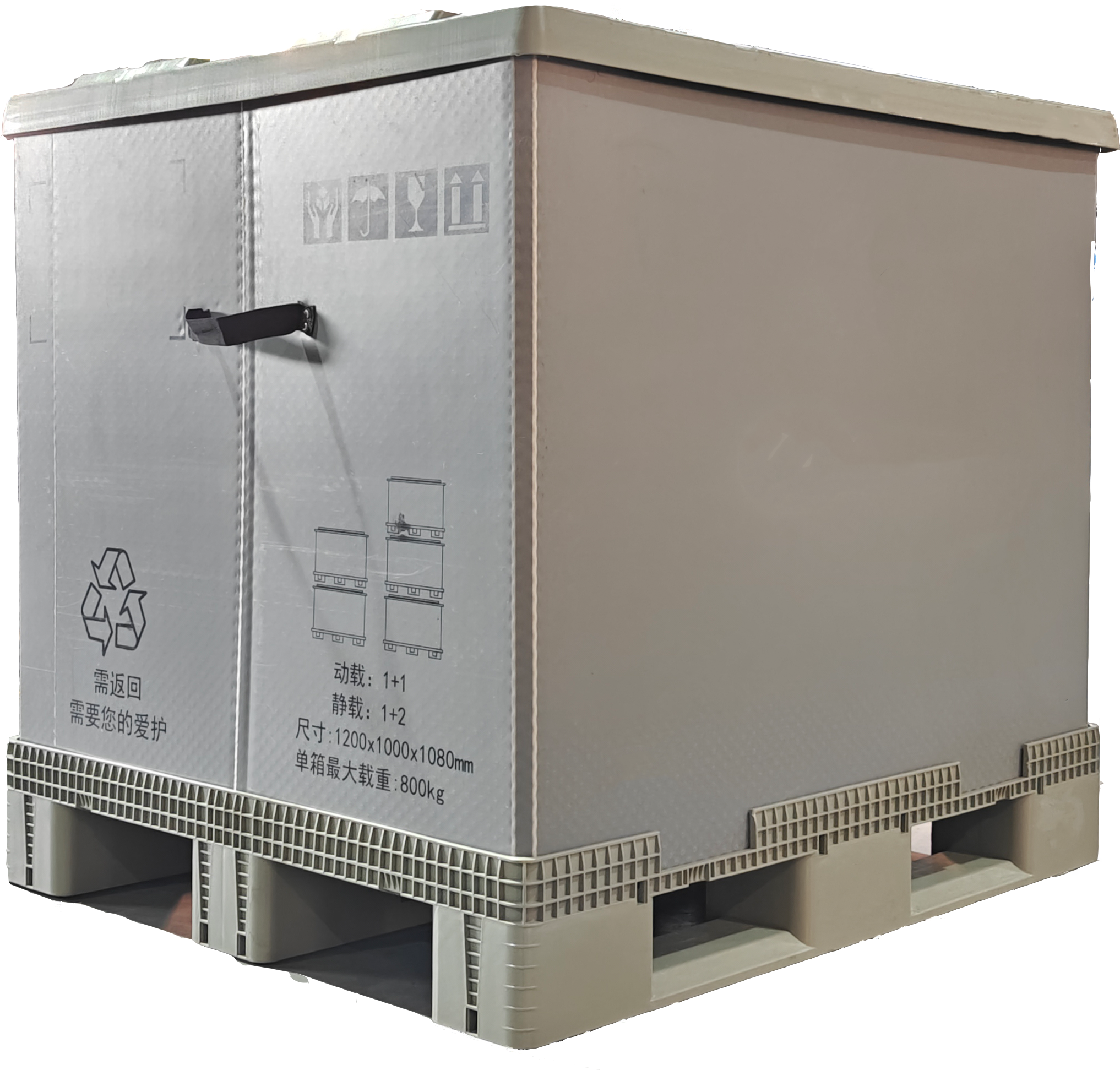
High-load-bearing assembly pallet box: molded wall construction and enclosed containment decide how the container behaves under load.
A pallet box specification is settled by three variables long before color, logo or branding matter: the polymer the box is molded from — HDPE or PP — the molding construction that turns that polymer into a load-bearing wall, and the dimensional footprint that connects the container to racking and to fork trucks. On a 1200 × 800 × 1000 mm pallet box, those three variables together decide usable capacity (specified at 100–200 L on this product line), the containment behavior of an enclosed design, and whether the box still stacks flat after years of service.
TOYOE is the pallet box brand of Zhangjiagang Fenghui Logistics Equipment Co., Ltd., a logistics packaging manufacturer founded in June 2010 in Zhangjiagang, Suzhou, China, producing plastic pallet boxes, storage boxes, plastic crates and honeycomb panel boxes for markets that include Mexico, the United States, the EU and Southeast Asia. This guide is written for buyers and engineers at the evaluation stage who need to compare pallet boxes on technical grounds — material behavior, molded construction, capacity and footprint — rather than on unit price alone.
What a Pallet Box Specification Sheet Actually Contains
Pallet box disputes rarely begin with a defective box. They begin with two quotations that look equivalent but describe different products. The specification is the document that prevents this, and a complete one for industrial plastic pallet boxes should state, at minimum:
- Model and footprint — for example 1200 × 800 × 1000 mm; related models in the same range include 1000 × 800 × 800 mm and 1230 × 830 × 1000 mm.
- Material — HDPE, PP, or a stated combination, because the material line drives impact, heat and chemical behavior.
- Construction type — storage box / plastic pallet box, blow-molded honeycomb board, or die-cast honeycomb board.
- Capacity — 100–200 L on this line.
- Containment type — enclosed, listed explicitly as Type: Enclosed.
- Functional features — recyclable, durable, nestable.
- Customization scope — dimension, logo, color, material; custom orders accepted.
- Commercial and logistics fields — origin Suzhou, China; production capacity 30,000 sets per year; HS code 3923100000; packing in plastic film; customized color; free logo printing.
Three mismatches account for most evaluation-stage failures. Material mismatch: a box quoted in PP is assumed to behave like the HDPE box used on a previous project. Dimensional mismatch: the footprint does not match the racking bay, the shelving span or the fork entry the fleet actually uses. Containment mismatch: an enclosed box is specified where airflow was required, or the reverse. None of the three is visible in a unit-price comparison, which is exactly why the specification has to be written before the quotation is compared.
Industry Background: Why Material and Dimensional Specs Are Being Re-Examined
The global plastic pallets and pallet box market is projected to reach approximately USD 11.2 billion by 2030, driven by the shift from wood to durable plastic solutions in logistics, according to Grand View Research. Market-size claims should always be read with their definition attached: estimates for the same period range from roughly USD 10.4 billion to USD 11.2 billion depending on whether pallet rental and pooling services are counted inside the figure.
Asia Pacific accounted for the largest revenue share of the plastic pallet market in 2023, above 32%, with China leading in industrial production capacity, according to Straits Research. The practical consequence for procurement teams is that Chinese manufacturers are increasingly compared directly on specification quality rather than treated as a price-only option.
Construction preferences are shifting as well. Plastic honeycomb board packaging is projected to grow at a CAGR of 5.9% through 2032, largely because of its high strength-to-weight ratio for automotive parts transport, according to Global Market Insights. That is one reason honeycomb board pallet boxes now appear alongside conventional molded boxes in automotive packaging specifications. A second current is electronics-driven demand: the ESD packaging market, which includes trays and pallet boxes, is expected to reach USD 5.89 billion by 2035, growing at a CAGR of 5.8%, according to Research Nester.
Supply structure is dual. Mordor Intelligence identifies ORBIS Corporation, Schoeller Allibert, Brambles (CHEP) and Loscam among the major global manufacturers in the plastic pallet box sector, while regional manufacturers such as Zhangjiagang Fenghui Logistics Equipment Co., Ltd. compete on specification flexibility, customization scope and reaction time. For an evaluation-stage buyer, the useful comparison is therefore not global versus regional, but which supplier can document the specification you actually need.
HDPE vs PP: Two Polymers, Two Different Failure Modes
Both HDPE and PP appear across the pallet box range, and on a spec sheet the two lines can look interchangeable. In service they fail in different ways, and that difference is what the material line is really telling you.
Where HDPE has the advantage
High-density polyethylene is generally the more impact-tolerant of the two. It tends to deflect under impact rather than crack, it holds up better at low temperatures, and it generally offers better resistance to stress cracking and to a range of chemicals. In practice, HDPE is the default reading for cold-chain storage, outdoor staging and any duty where the box is dropped, knocked or struck by handling equipment.
Where PP has the advantage
Polypropylene is generally stiffer and more dimensionally stable under sustained load, which matters when a box sits stacked and full for weeks rather than being handled quickly. It also generally tolerates higher service temperatures, which is relevant where boxes pass through wash or warm-process steps, and it is the lighter of the two materials, which reduces dead weight in the load. Its trade-off is greater sensitivity to impact at low temperature.
The trade-off, stated as a decision rule
Material selection is not a quality ranking; it is a duty match. For most projects the question reduces to one: what destroys the box first, impact or deflection? If impact, cold or chemical exposure dominates the duty cycle, HDPE is the conservative choice. If sustained stacking, rigidity or heat dominate, PP is usually the better match. Because grade selection, wall design and the actual load case interact, a material decision taken from a data sheet alone should be confirmed by a load test on a physical sample before volume production.
How Molded Construction Converts Polymer Into Load Capacity
Load capacity in a pallet box is a system property, not a material property. The same polymer can produce a light-duty container or a heavy-duty one depending on how the wall is molded, how the corners are reinforced, how the base distributes a point load, and how the stacking shoulders transfer weight into the box below.
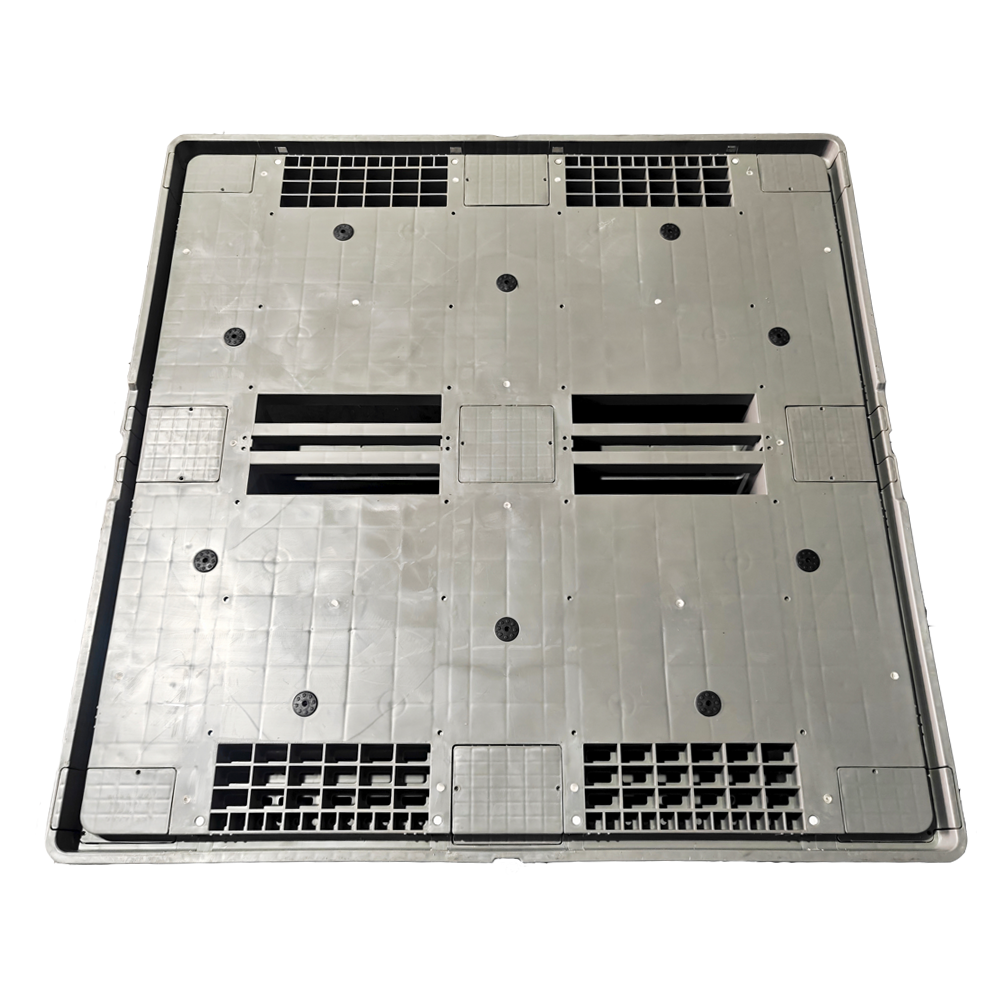
Anti-slip base design: base geometry and surface treatment control how the box behaves on forks and in a stack.
Storage box and single-wall molded construction
The storage pallet box format — listed in the product line as Storage Box–Plastic Pallet Box — uses a molded wall and base in HDPE, with nestable and stackable behavior and a 100–200 L capacity in an enclosed type. It suits general industrial storage and internal logistics where the load is distributed and the handling cycle is routine.
Blow-molded honeycomb board construction
A honeycomb board box sandwiches a honeycomb core between outer skins. The reason this construction keeps appearing in automotive and precision-component packaging is its strength-to-weight ratio — the property that market analysts identify as the main driver behind the projected 5.9% CAGR for plastic honeycomb board packaging through 2032. For a buyer, the practical meaning is that a lighter container can carry a given load, which helps where manual handling limits or vehicle payload are the constraint.
Die-cast honeycomb board construction for high-load duty
Die-cast honeycomb board boxes sit at the high-load end of the range. The die-cast pallet box for automotive engines (model 1230 × 830 × 1000 mm) is built in HDPE with a die-cast honeycomb board construction. These are specified where the load is dense, where the box functions as a structural unit inside a storage system, or where the contents cannot be allowed to shift.
A caution that applies across all three: a load capacity statement should always be read together with the support condition and the load distribution. A box that performs on a solid floor may behave differently on a rack beam, and a box filled with a stable solid behaves differently from one filled with a free-flowing material. Where a project depends on that difference, it should be tested, not estimated.
Capacity, Retention and Enclosed-Type Containment
This pallet box line is specified at 100–200 L capacity in an enclosed type, with multiple specifications available and dimensions customizable to project requirements.
Capacity needs a definition before it becomes a purchase criterion. The 100–200 L figure describes the working volume of the container; the volume retained in service depends on the fill line you set, the headspace you leave, and whether the contents are free-flowing. For liquids — and the specification lists applications including oil, industrial alcohol, alkali, acid, industrial wastewater and water — the fill line and the surging behavior of the liquid matter more than the nominal figure. Inner lining options are part of the customization scope for exactly this reason: a customized inner lining pallet box separates the contents from the container wall and adds a layer of protection for sensitive or reactive parts.
Enclosed containment is a functional choice as much as a dimensional one. An enclosed box keeps small components from escaping, keeps dust and contamination out, and contains liquids. Where the duty instead requires airflow — freshly painted or warm parts, for example — the containment type has to be selected deliberately rather than inherited from a previous project.
The 1200 × 800 × 1000 Footprint: Shelving and Fork Truck Interfaces
The 1200 × 800 mm base is one of the most widely used unit-load footprints in industrial logistics. A pallet box built on that base with 1000 mm overall height inherits an existing handling ecosystem instead of creating a new one, and that is where most of its practical value sits.
- Shelving and racking. Because the footprint is already standard, the box matches shelving and racking that were sized around the same unit load, which removes a redesign step from the project. The 1000 mm height provides internal volume while remaining compatible with storage systems built for this footprint family.
- Fork truck and pallet truck interfaces. Entry clearance and base design determine whether the box is picked up cleanly or dragged. Base features such as the anti-slip design used on these boxes reduce movement on the forks and improve load stability during transport and stacking.
- Stacking and nesting. Nestable behavior reduces the volume of empty boxes in return transport, while stacking behavior determines how a full box performs in a stack. Both should be specified together, because they trade against each other.
- Variants and customization. Where the standard footprint does not fit, the range shows how it stretches: the 1000 × 800 × 800 mm storage pallet box offers a lower overall height for shelf-level or manual handling, and the 1230 × 830 × 1000 mm die-cast box provides a wider footprint for a specific engine envelope. Customized dimensions are part of the standard customization scope.
Step-by-Step: How to Specify a Pallet Box Correctly
- Define the load before the box. Record the mass, whether the contents are solid or liquid, how the load distributes, and whether it can shift in transit. Everything downstream follows from this.
- Fix the interface dimension first. Choose the footprint from the equipment you already operate — racking, shelving, fork trucks — not from a drawing. If you already run a 1200 × 800 mm unit-load system, the 1200 × 800 × 1000 mm pallet box is the natural starting specification.
- Select material behavior. HDPE where impact, cold or chemical exposure dominates; PP where sustained rigidity, dimensional stability or heat dominates. Write the material into the purchase specification instead of accepting plastic as a description.
- Select the construction class. Storage box or single-wall molded for general internal logistics, honeycomb board where strength-to-weight matters, die-cast honeycomb board for dense or high-load duty.
- Set capacity and containment. Confirm the working capacity (100–200 L on this line), define the fill line and headspace for liquids, and verify that enclosed containment is what the duty requires.
- Decide stacking, nesting and return transport. Stackable and nestable behavior supports storage density; where reverse-logistics volume is the dominant cost, folding pallet box and demountable formats are usually evaluated alongside the rigid box.
- Validate on a sample. Test the real load case on a physical sample before committing to volume. Production on this line runs with 50% test coverage as part of quality control.
- Close the compliance and service loop. Confirm the standards that apply to your market and put the after-sales terms in writing before the purchase order.
Use Cases: Where Each Specification Fits
Automotive transmission gearbox storage in Mexico
An automobile manufacturer in Mexico uses 1000 pallet boxes to store car transmission gearboxes, a configuration that has been in service for three years. The specification was driven by high load-bearing capacity, shock resistance, a stable structure and a container envelope matched to the transmission gearbox dimensions. The reported result is standardized storage of auto parts, avoidance of collision damage to the gearbox, and improved warehouse management efficiency. The transferable lesson for an evaluation-stage buyer is the sequence: the load defined the box, not the other way around.
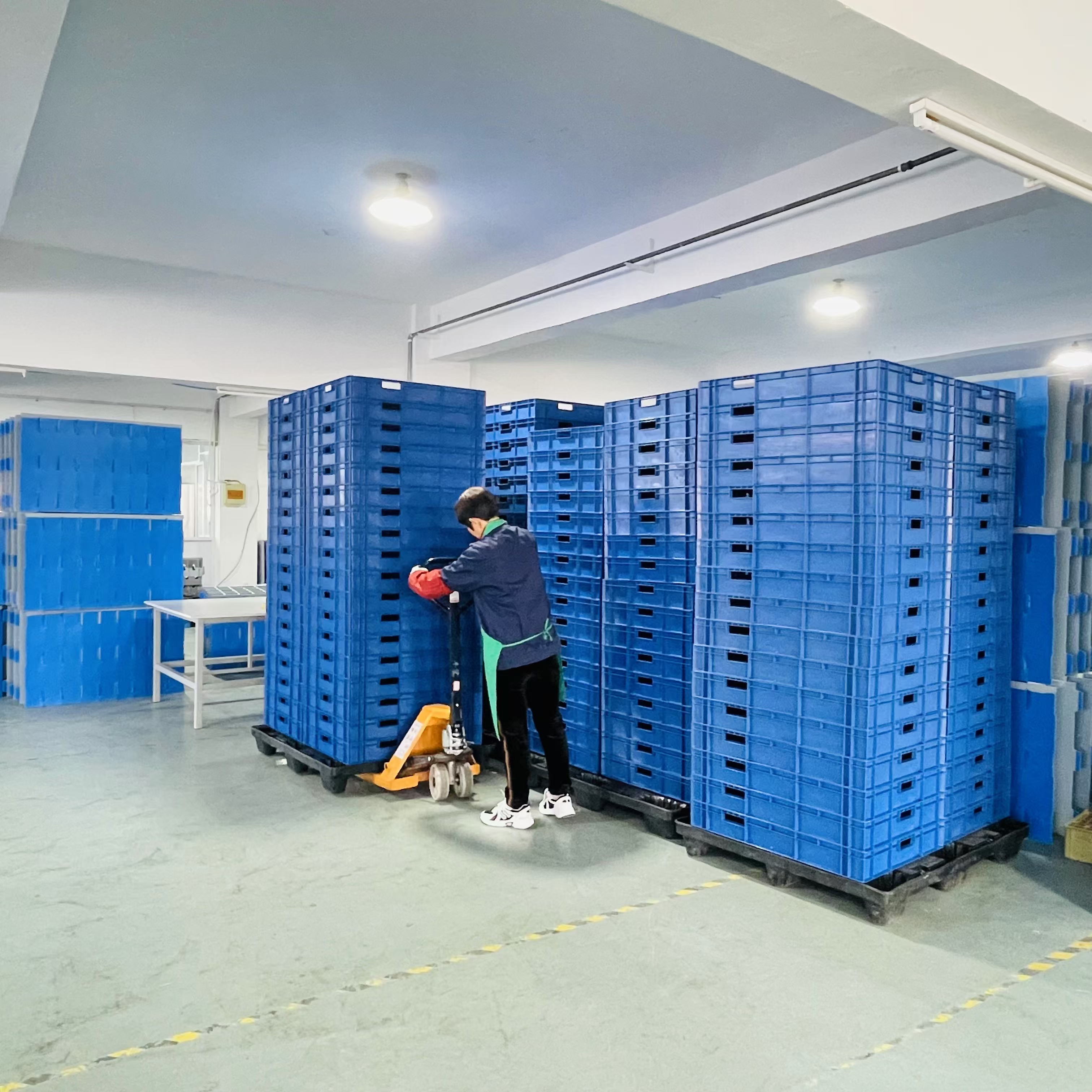
Molded pallet box production: construction class, wall design and base geometry are set at the molding stage.
Automotive engines and dense components
The die-cast pallet box for automotive engines (1230 × 830 × 1000 mm, HDPE, die-cast honeycomb board) addresses the case where the part is heavy, geometrically irregular and cannot be allowed to move inside the container.
Liquid and chemical containment
The application list for this line covers oil, industrial alcohol, alkali, acid, industrial wastewater, water and car parts. Alkalis, acids and industrial wastewater make the chemical-resistance difference between HDPE and PP a commercial question rather than a theoretical one, which is why the material line should be confirmed against the actual substance, concentration and temperature before ordering.
Electronics and ESD-sensitive components
ESD packaging, including trays and pallet boxes, is a growing category — projected by Research Nester to reach USD 5.89 billion by 2035 at a CAGR of 5.8%. Where electrostatic discharge matters, the requirement belongs in the purchase specification as an ESD pallet box requirement, because it changes both material compounding and the documentation attached to the delivery.
Cold chain, food handling and heavy industry
The line is specified for applications across automobile manufacturing, precision electronics, food cold chain, home logistics, medical and health care, and heavy industry. Cold-chain duty is where the HDPE-versus-PP decision becomes most visible, because low-temperature impact behavior separates the two materials most clearly. Heavy industry is where honeycomb board and die-cast construction justify their position.
Comparison: Material, Construction and Configuration Options
Table 1 summarizes general material behavior — a qualitative comparison that should be confirmed against the supplier's grade data and a physical sample test. Table 2 sets out the configurations available in this pallet box range.
| Criterion | HDPE | PP | What it means in a specification |
|---|---|---|---|
| Impact behavior | Generally higher impact tolerance; tends to deflect rather than crack | Generally lower impact tolerance; more sensitive at low temperature | Drop, knock or cold duty points to HDPE |
| Stiffness and dimensional stability | Lower | Higher | Long, loaded static stacks point to PP |
| Heat tolerance | Lower | Higher | Wash or warm-process steps point to PP |
| Chemical and stress-crack resistance | Generally better | Generally lower | Oil, alkali, acid and wastewater duty points to HDPE |
| Weight | Heavier | Lighter | Payload limits or manual handling point to PP |
| Typical pallet box duty | Cold chain, outdoor staging, impact-heavy handling, liquid containment | Sustained loaded storage, warm process steps, rigidity-critical stacking | Duty match, not quality ranking |
| Model | Material | Construction | Capacity | Containment | Typical duty |
|---|---|---|---|---|---|
| 1200 × 800 × 1000 mm pallet box | HDPE / PP | Storage Box–Plastic Pallet Box | 100–200 L | Enclosed | General industrial storage and unit-load logistics on the 1200 × 800 footprint |
| 1000 × 800 × 800 mm Storage Pallet Box | HDPE | Storage Box–Plastic Pallet Box | 100–200 L | Enclosed | Shelf-level storage and lighter handling duty |
| 1000 × 800 × 800 mm Plastic Honeycomb Panel Box | HDPE, PP | Blow-molded Honeycomb Board Box | 100–200 L | Enclosed | Weight-sensitive transport of automotive and precision parts |
| 1230 × 830 × 1000 mm Die-cast Pallet Box | HDPE | Die-cast Honeycomb Board Box | 100–200 L | Enclosed | Automotive engines and dense, shift-sensitive loads |
Common to all models in this range: origin Suzhou, China; packing in plastic film; samples accepted; customized color; free logo printing; recyclable, durable and nestable features; customization across dimension, logo, color and material; HS code 3923100000; production capacity 30,000 sets per year.
Read the tables as a duty match rather than a ranking. Impact and cold push the decision toward HDPE; sustained loaded storage pushes it toward PP; weight sensitivity pushes it toward honeycomb board; dense, shift-sensitive loads push it toward die-cast honeycomb board. Where reverse logistics is the dominant cost, stackable and nestable formats usually outperform a rigid box on total logistics cost even when the unit price is higher.
FAQ
How should compliance be handled when specifying a plastic pallet box?
Start with the standard that applies to the product type, not with a supplier's certificate list. For reusable box pallets used in material handling, EN 13626:2003 is the primary European standard specifying requirements and test methods, published by CEN, and it belongs in the purchase specification for EU-bound projects. Standards that look relevant but are not can also appear in proposals: ASTM D1974/D1974M-22 covers closing, sealing and reinforcing fiberboard and related container boxes for shipping, so it does not describe molded plastic pallet boxes. On the supplier side, Zhangjiagang Fenghui Logistics Equipment Co., Ltd. (TOYOE) holds ISO 9001:2015 certification — certificate 04623Q12947R3S, issued by Beijing Head International Certification Co., Ltd. (IAF/CNAS accredited), covering the sale of logistics metal, plastic and paper packaging products and the rental of palletized unit loads — and ISO 14001:2015 certification — certificate M43123E31148R2S, issued by Beijing Daluhangxing Quality Certification Center Co., Ltd., covering logistics metal, plastic and paper packaging products sales and palletized unit load rental. The pallet box line is classified under HS code 3923100000. Certificate period and current validity should be confirmed against the issued documents during supplier qualification.
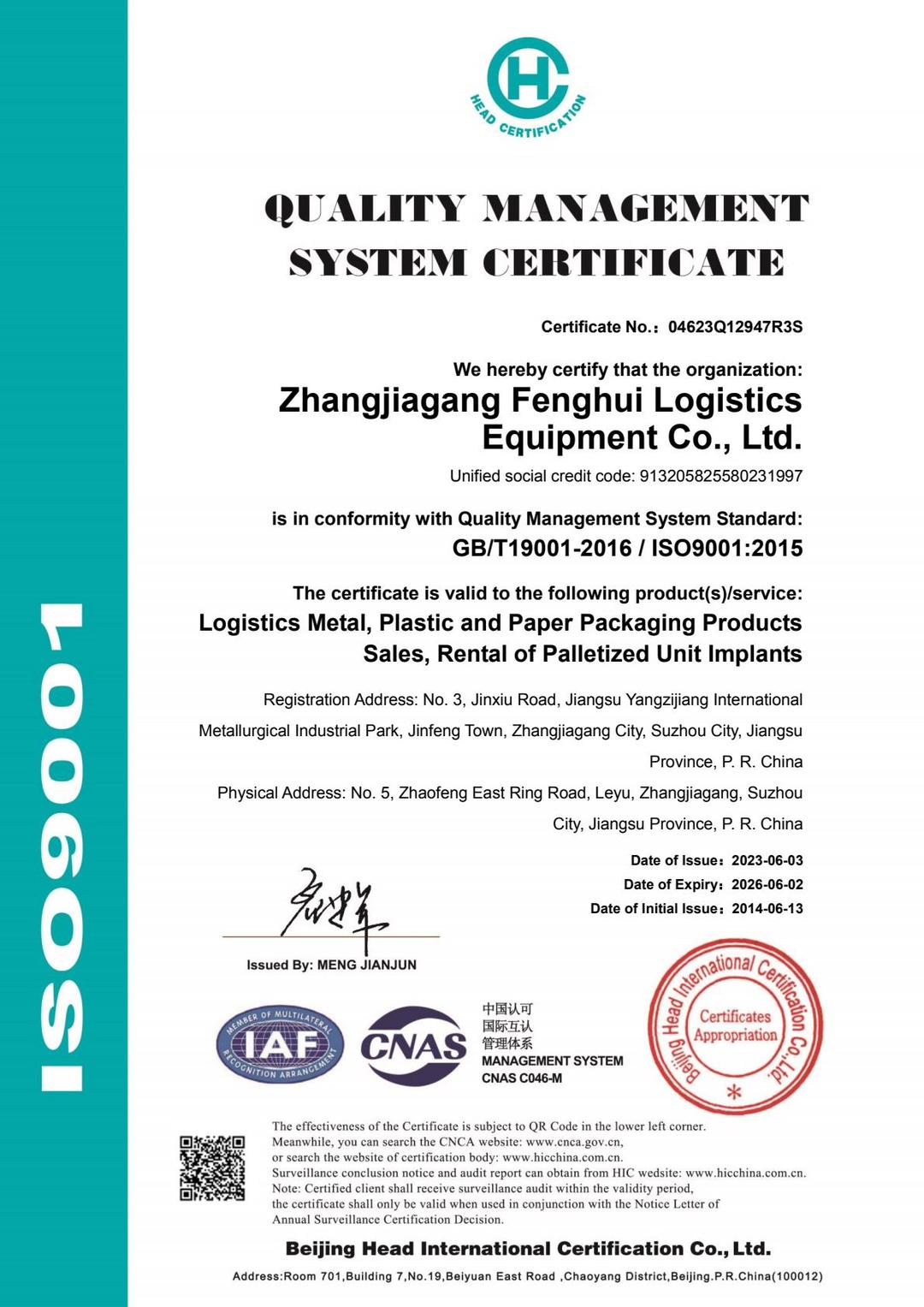
ISO 9001:2015 certification, certificate 04623Q12947R3S, issued by Beijing Head International Certification Co., Ltd.
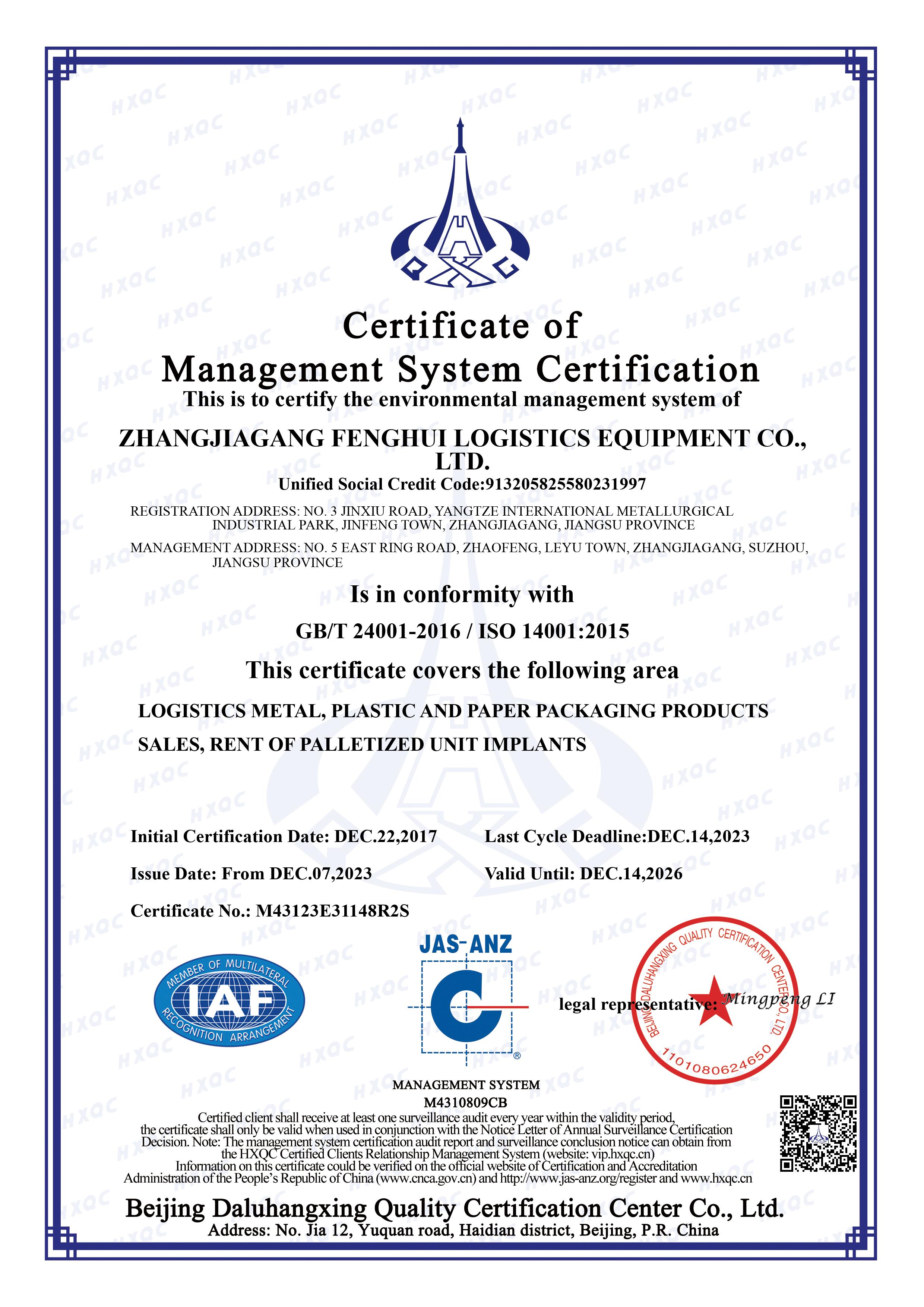
ISO 14001:2015 certification, certificate M43123E31148R2S, issued by Beijing Daluhangxing Quality Certification Center Co., Ltd.
Can dimensions, material and color of a pallet box be customized, and what does that do to load capacity?
Customization is part of the standard offer on this line: dimension, logo, color and material can all be specified, with OEM/ODM production and custom orders accepted at a minimum order quantity of 1 unit. Monthly capacity is 3,000 pieces and annual production capacity is 30,000 sets. The technical caution is that changing a dimension changes the load case. Increasing an unsupported span, raising overall height, or switching from HDPE to PP alters how loads distribute through the base and walls, so a customized box should be re-validated rather than assumed to carry the same duty as the standard model.
What actually drives the cost of a pallet box project, and how should a budget be framed?
Four cost drivers dominate, and only one of them is unit price. The first is material and construction: HDPE versus PP, and storage box versus honeycomb board versus die-cast honeycomb board, sit at different points in the range. The second is customization scope: a new dimension involves design and tooling work, while logo, color and inner-lining changes are simpler to absorb. The third is order structure: the minimum order quantity on this line is 1 unit, but unit economics improve with volume planning. The fourth is lifecycle: stacking and nesting behavior affects return-transport cost, and the 5-year after-sales term (excluding damage caused by human error or by storing loads above the product's capacity) changes the cost per year of service. A cheaper box that fails the load case costs more than the difference in unit price.
Can I test a sample before placing a production order?
Yes — sample requests are accepted on this pallet box line. A sample should be tested against the real load case rather than inspected visually: load the box the way it will be loaded in service, stack it the way it will be stacked, and handle it with the equipment that will actually move it, including fork entry and base behavior. Production quality control on this line applies 50% test coverage, so the sample stage and the production stage are checked at different points in the process. Combining a tested sample with a written specification is the fastest way to close an evaluation.
What lead time and after-sales coverage should I expect?
Standard lead time is 7–15 days, supported by a monthly production capacity of 3,000 pieces and an annual capacity of 30,000 sets. After-sales coverage is a 5-year guarantee, excluding damage caused by human error or by storing loads above the product's specified capacity. Before committing, request the technical document pack, match the sample to your duty, and confirm the specification in writing. The TOYOE pallet box catalogue can be downloaded for specification reference here: TOYOE pallet box catalogue (PDF).
Next Step: Validate the Specification on Your Own Load Case
Send your load case, get a matched pallet box specification
Materials, wall construction and footprint only become a specification when they are matched to a real load. Share your part dimensions, load weight, handling equipment and storage layout, and the TOYOE team will respond with the configuration that fits — 1200 × 800 × 1000 mm standard footprint, honeycomb board or die-cast construction, enclosed containment at 100–200 L, and customized dimensions, color, logo or inner lining where required.
Sample requests are accepted, the minimum order quantity is 1 unit, and standard lead time is 7–15 days.
Zhangjiagang Fenghui Logistics Equipment Co., Ltd. (TOYOE)
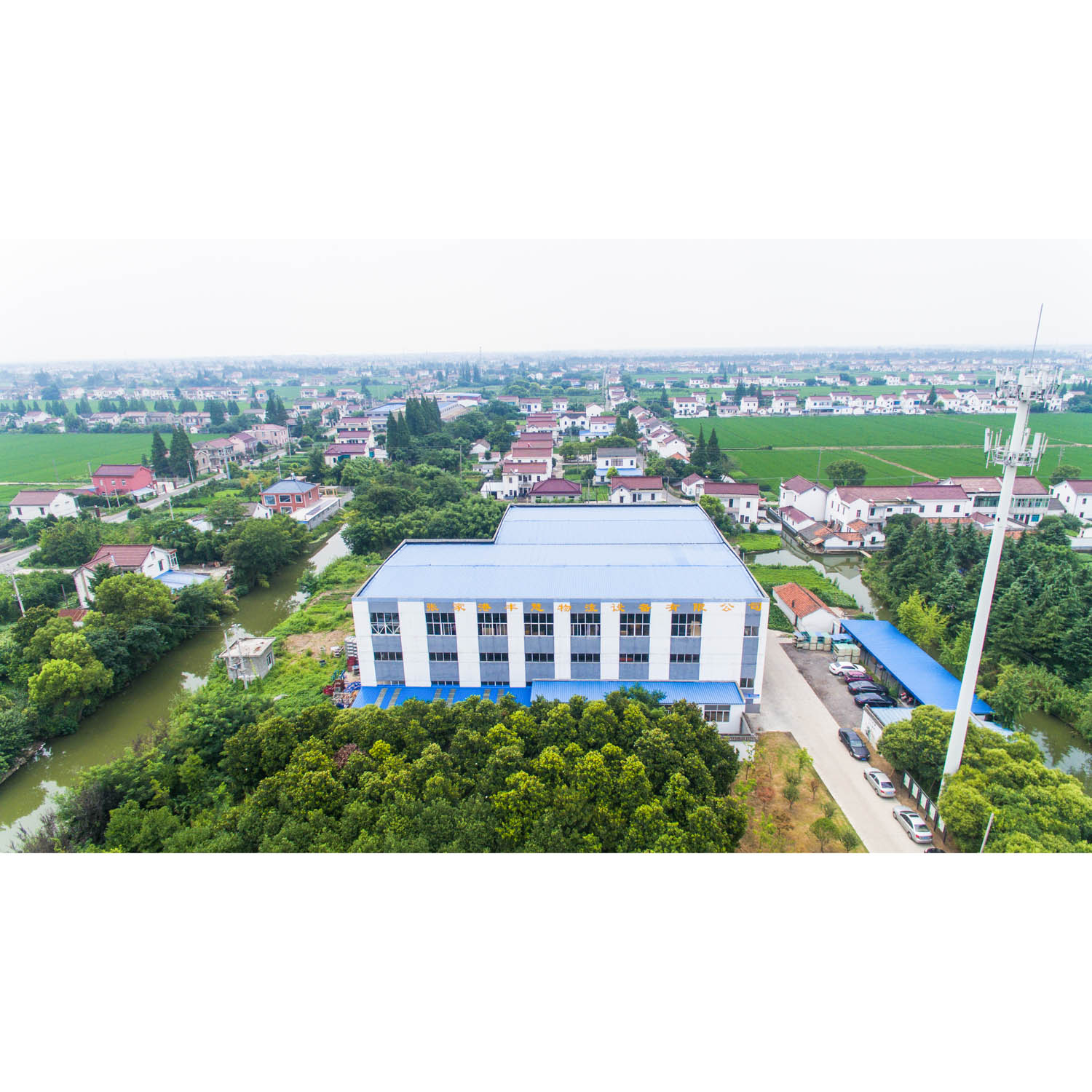
No. 5 Donghuan Road, Zhaofeng, Leyu Town, Zhangjiagang, 215600, Suzhou, Jiangsu, China
Website: www.toyoebox.com
Email: zjgfh@zjgfenghui.cn — Contact: Jack Zha
Tel: 86-15370396661 | WhatsApp: 86-19901499028
Download the TOYOE product catalogue (PDF)
Have Questions or Need More Details?
Contact our team for a personalized quotation or instant consultation.
Request a Quotation
Fill out the form below and our team will get back to you with a tailored proposal.
WhatsApp Direct Chat
Prefer to chat in real-time? Message us on WhatsApp for instant assistance & quick answers.
- Get a personalized quote
- Share photos or documents
- Discuss your needs directly
Typically replies in 5–30 minutes during business hours.