Enclosed HDPE Pallet Box Parameters for Chemical & Auto Parts Storage
Enclosed HDPE Pallet Box Parameters for Chemical & Auto Parts Storage
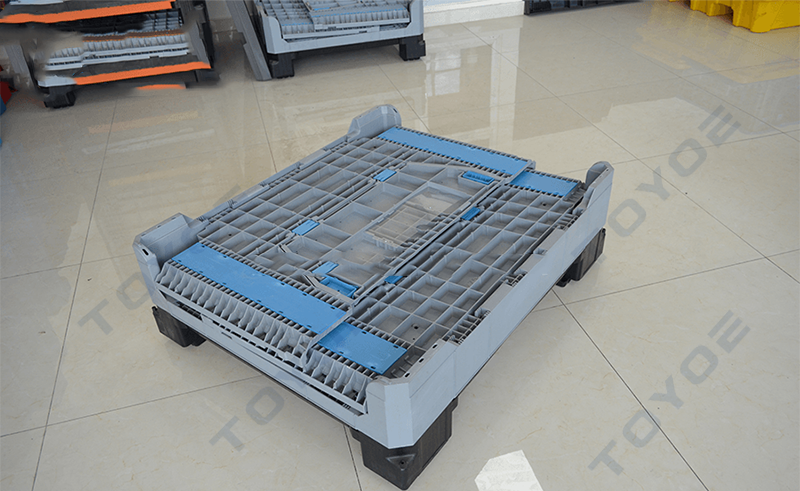
Cover: TOYOE enclosed pallet box — recyclable, durable and nestable construction for chemical and automotive storage projects.
An enclosed HDPE pallet box is a closed-wall, reusable industrial container used to hold chemical media and automotive components during storage, stacking and transport. For a buyer, the useful question is not whether a pallet box exists, but whether one specific box matches the load, the handling equipment and the storage environment. TOYOE builds enclosed pallet boxes in three documented footprints — 1200 × 800 × 1000 mm, 1000 × 800 × 800 mm and a 1230 × 830 × 1000 mm die-cast model — with a usable capacity range of 100–200 L, in HDPE or PP, with recyclable, durable and nestable construction. This guide breaks down each parameter, the documented values behind it, and how to convert those values into a purchase specification for chemical and auto parts storage.
The Real Problem: Pallet Box Failures Are Usually Parameter Mismatches
An enclosed pallet box rarely fails because a wall is too thin. It fails because the specification behind the box was never matched to the job. In chemical and automotive storage, the recurring mismatch patterns are predictable:
- Footprint mismatch. A box that does not sit cleanly on an existing pallet position, warehouse shelf or racking bay forces manual handling and slows every cycle.
- Enclosure mismatch. An open container exposed to dust, humidity or wide temperature swings cannot deliver the moisture-proof and dust-proof behaviour that an enclosed type is specified for.
- Material mismatch. HDPE and PP are both offered in TOYOE pallet boxes, but they are not interchangeable for every medium in the application list, which covers oil, industrial alcohol, alkali, acid, industrial wastewater, water and car parts.
- Handling mismatch. A box that cannot be lifted by forklift or placed by logistics handling equipment becomes a bottleneck in a 24/7 operation.
- Load-boundary mismatch. The TOYOE after-sales guarantee runs for 5 years but explicitly excludes damage caused by human error or by excessive storage weight. That exclusion is a signal: the load boundary is a specification input, not an afterthought.
The purpose of a parameter-led selection process is to remove these five risks before an order is placed, instead of discovering them in the warehouse.
Industry Background: Why Parameter Discipline Is Tightening
Two market shifts explain why buyers are now specifying pallet boxes more precisely than they did a decade ago. First, plastic is replacing wood in logistics handling. Grand View Research projects the global plastic pallets and pallet box market to reach approximately USD 11.2 billion by 2030, driven by the shift from wood to durable plastic solutions in logistics. Straits Research reports that Asia Pacific accounted for the largest revenue share — over 32% — of the plastic pallet market in 2023, with China leading in industrial production capacity.
Second, the enclosure material itself is evolving. Global Market Insights projects the plastic honeycomb board packaging market to grow at a CAGR of 5.9% through 2032, largely because of its high strength-to-weight ratio for automotive parts transport. Honeycomb board is the construction behind several TOYOE enclosed box variants, and it is the reason a closed box can stay light while still holding a stable structure under stacking.
Electrostatic protection is the third driver. Research Nester projects the ESD packaging market — including trays and pallet boxes — to reach USD 5.89 billion by 2035, growing at a CAGR of 5.8%. For buyers handling precision automotive or electronic parts, anti-static tray and inner-lining options have moved from optional accessory to specification line item.
On the supply side, Mordor Intelligence lists ORBIS Corporation, Schoeller Allibert, Brambles (CHEP) and Loscam among the major global manufacturers in the plastic pallet box sector. Their presence, together with the EN 13626:2003 standard published by CEN for reusable box pallets used in material handling, gives buyers a common vocabulary for comparing suppliers on parameters rather than on price alone. EN 13626:2003 specifies requirements and test methods for reusable box pallets generally; it is a test-method reference, not a certificate issued to any single product.
The Base Specification: Documented TOYOE Enclosed Pallet Box Parameters
TOYOE is the pallet box brand of Zhangjiagang Fenghui Logistics Equipment Co., Ltd., a logistics packaging manufacturer founded in 2010 in Zhangjiagang, Suzhou, Jiangsu, China, producing plastic pallet boxes, storage boxes, plastic crates and honeycomb panel boxes. The parameter block below applies across the enclosed pallet box range and is the fastest way to check whether a project can be quoted directly or needs a custom dimension.
| Parameter | Documented value |
|---|---|
| Box type | Enclosed |
| Material | HDPE / PP |
| Capacity | 100–200 L |
| Sizes | Multiple specifications; can be customized |
| Design features | Recyclable, durable, nestable |
| Colour | Customized colour |
| Logo | Free printing |
| Custom order | Accepted (OEM / ODM) |
| Application media | Oil, industrial alcohol, alkali, acid, industrial wastewater, water, car parts |
| Applicable industries | Automobile manufacturing / precision electronics / food cold chain / home logistics / medical and health care / heavy industry |
| MOQ | 1 unit |
| Sample | Accepted |
| Production lead time | 7–15 days |
| Monthly capacity | 3,000 pieces |
| Annual production capacity | 30,000 units |
| Quality control | 50% test |
| Packing | Plastic film |
| Origin | Suzhou, China |
| HS Code | 3923100000 |
| After-sales | Guaranteed for 5 years (excluding cases of damage due to human error or excessive storage weight of the product) |
Model Comparison: 1200 × 800, 1000 × 800 and the 1230 × 830 Die-Cast Box
The three documented footprints serve different loads. The comparison below uses only the values published in the TOYOE product specifications; it does not estimate weight ratings for any model.
| Parameter | 1200 × 800 × 1000 mm | 1000 × 800 × 800 mm | 1230 × 830 × 1000 mm (die-cast) |
|---|---|---|---|
| Listing name | Pallet box | Storage Pallet Box; Plastic Honeycomb Panel Box | Die-cast pallet boxes for automotive engines |
| Construction | Plastic honeycomb panel box | Blow-moulded honeycomb board box | Die-cast honeycomb board box |
| Type | Enclosed | Enclosed | Enclosed |
| Material | PP, HDPE | HDPE; honeycomb variant HDPE, PP | HDPE |
| Capacity | 100–200 L | 100–200 L | 100–200 L |
| Colour and logo | Customized colour; free logo printing | Customized colour; free logo printing | Customized colour; free logo printing |
| Documented fit | Automotive component and gearbox storage; logistics warehousing | General industrial storage with honeycomb board walls | Automotive engine and die-cast part storage |
| Linked reference project | Mexico gearbox storage, 1,000 pieces, 3 years | Mexico gearbox storage programme related product | Mexico gearbox storage programme related product |
Read the table as a fit test, not a ranking. If the load is a transmission gearbox, the 1200 × 800 × 1000 mm enclosed box is the documented fit. If the load is an engine or a large die-cast part, the 1230 × 830 × 1000 mm die-cast box is the documented fit. If the priority is a lighter honeycomb structure for general industrial storage, the 1000 × 800 × 800 mm box family — including the Plastic Honeycomb Panel Box — is the documented option.
Step-by-Step: How to Specify an Enclosed Pallet Box for Your Project
Step 1 — Define the medium before the box. Write down exactly what goes into the box. The TOYOE application list covers oil, industrial alcohol, alkali, acid, industrial wastewater, water and car parts. If the medium is a liquid or a wet part, the enclosure and material become the deciding parameters; if the medium is a dry casting, the deciding parameter is usually the inner locating structure.
Step 2 — Fix the footprint against existing infrastructure. Measure the racking bay, warehouse shelf and pallet position the box has to sit in. Then choose between 1200 × 800 × 1000 mm, 1000 × 800 × 800 mm or the 1230 × 830 × 1000 mm die-cast footprint. If none matches, dimension customization is available.
Step 3 — Choose the polymer. Both HDPE and PP are offered. As a general rule in industrial packaging, HDPE is commonly selected where chemical resistance and impact toughness are the priorities, while PP is often selected where higher service temperature matters more. Because both appear across the TOYOE range, the material decision should be confirmed with the supplier against the specific medium list rather than assumed.
Step 4 — Confirm enclosure, stacking and nesting behaviour. Enclosed construction addresses dust and moisture. Nestable construction reduces the volume occupied by empty boxes, which is a direct warehouse-space decision. Where stacking stability is the requirement, the anti-slip base design shown in the range supports stable stacking in high-bay storage.
Step 5 — Verify the handling interface. The documented project equipment set for this application is forklift, warehouse shelf, logistics handling equipment and anti-static measures. A box that has not been checked against all four will eventually be handled manually.
Step 6 — Confirm the working environment. The documented Mexico logistics project operates in high humidity, dust, a wide temperature range, with waterproof and anti-static requirements, and 24/7 operation. Copy that checklist and mark which lines apply to your site.
Step 7 — Specify the customization scope. Dimension, logo, colour and material are the four documented customization axes. Logo printing is free.
Step 8 — Lock the commercial terms. MOQ is 1 unit, samples are accepted, production lead time is 7–15 days, packing is plastic film, the HS Code is 3923100000, and quality control follows a 50% test protocol.
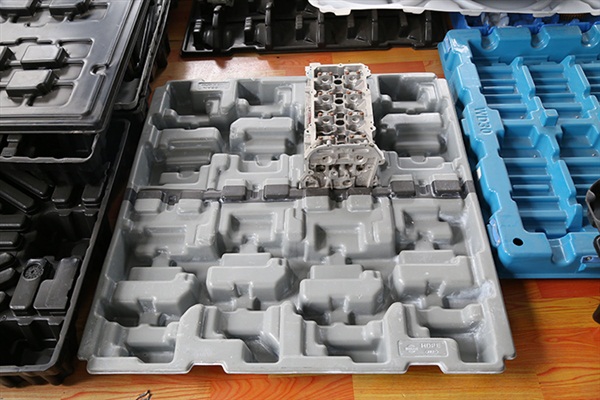
Supporting: heavy-duty vacuum-formed inner lining tray, one of the customization options inside an enclosed TOYOE pallet box.
Customization Options: Dimension, Colour, Material, Logo and Inner Lining
Customization is the point at which a general-purpose enclosed pallet box becomes a project box. Four axes are documented in the TOYOE capability set — dimension, logo, colour and material — under an OEM/ODM production mode. Logo printing is free of charge.
Beyond the box shell, the inner lining is where automotive projects are usually won or lost. Trays in the TOYOE range include a heavy-duty vacuum-formed inner lining tray, a booster vacuum-formed inner lining tray, a transmission blister inner lining tray and an anti-static blister tray. A blister tray locates a part in a fixed position inside the enclosed box, which is what prevents contact between components during transport and stacking. For buyers who need electrostatic protection, the anti-static blister tray is the documented accessory; the ESD packaging market trend described by Research Nester shows why this line item now appears in more specifications.
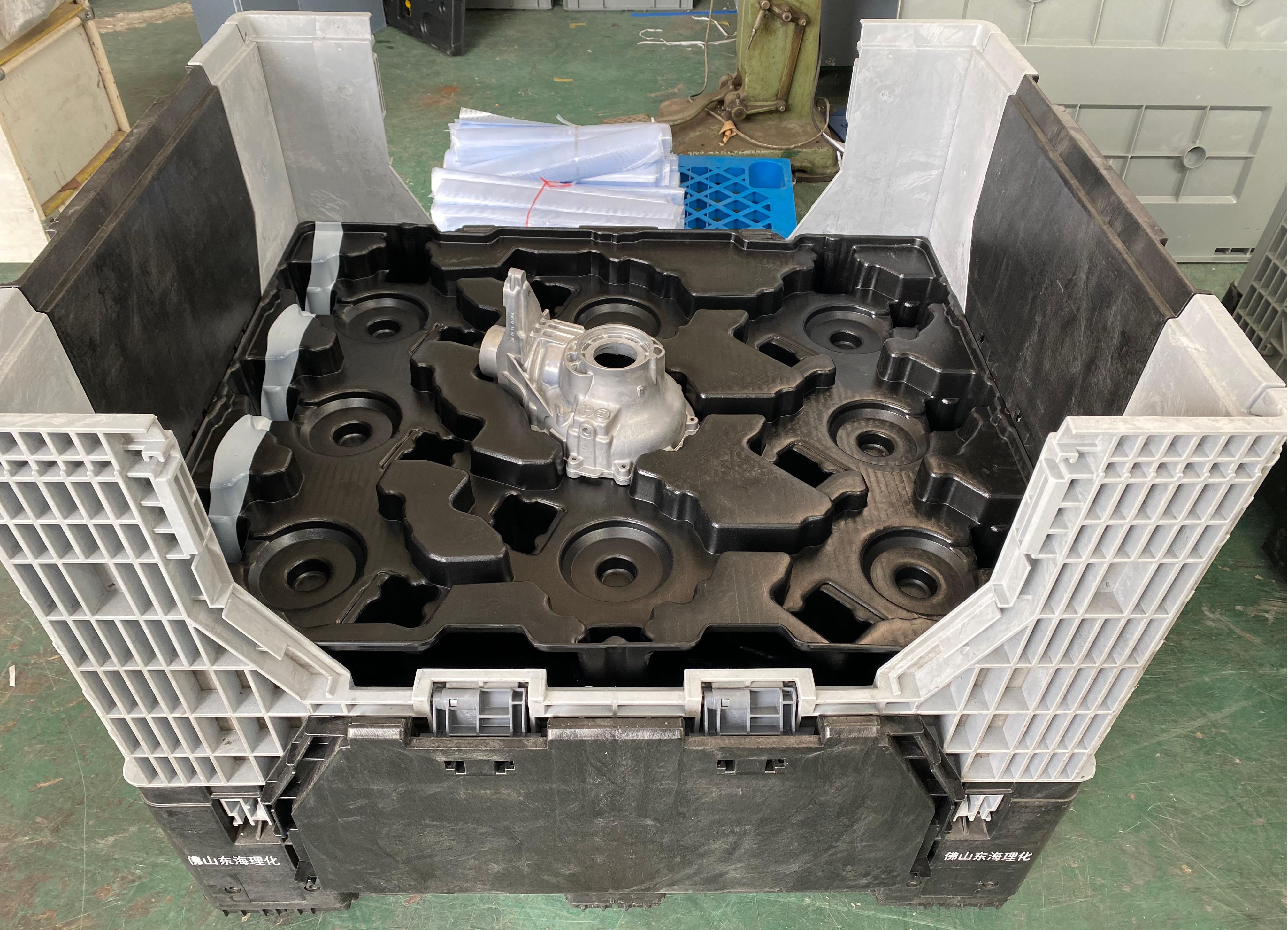
Supporting: transmission blister inner lining tray — part-specific locating for gearbox storage.
Custom dimension deserves a note on the cost side. A new dimension usually means a new mould or a modified one, so the practical sequence is: first check whether one of the three documented footprints already fits, then test a sample, then invest in a custom dimension once the project volume justifies it.
Use Cases: Chemical Media and Automotive Parts Storage
Chemical and liquid-adjacent storage. The documented application list covers oil, industrial alcohol, alkali, acid, industrial wastewater and water. Enclosed construction keeps those contents separated from dust and moisture, and the reusable construction supports repeated circulation rather than single-use packaging.
Automotive parts storage. The strongest documented evidence is a three-year programme for an automobile manufacturer in Mexico, using 1,000 pieces to store car transmission gearboxes. Reported outcomes were standardized storage of auto parts, avoided collision damage to gearboxes, and improved warehouse management efficiency. The documented highlights behind that result were high load-bearing capacity, shock resistance and a stable structure sized to fit the transmission gearbox.
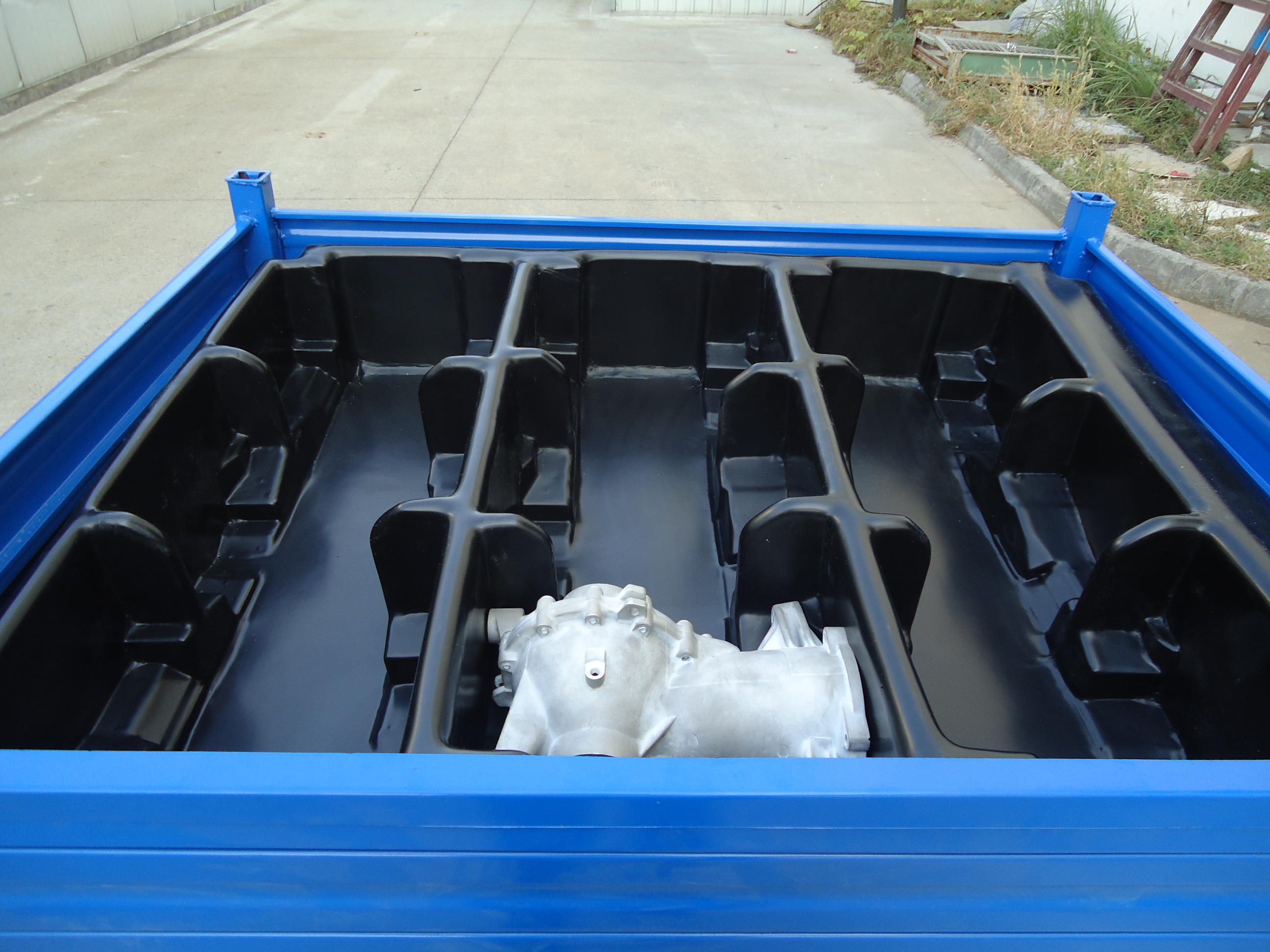
Use case: enclosed pallet boxes with vacuum-formed trays in automotive component storage.
Anti-static environments. Where the storage area carries an anti-static requirement, the box and the tray have to be treated as one system. The anti-static blister tray shown below is the documented element on the accessory side.
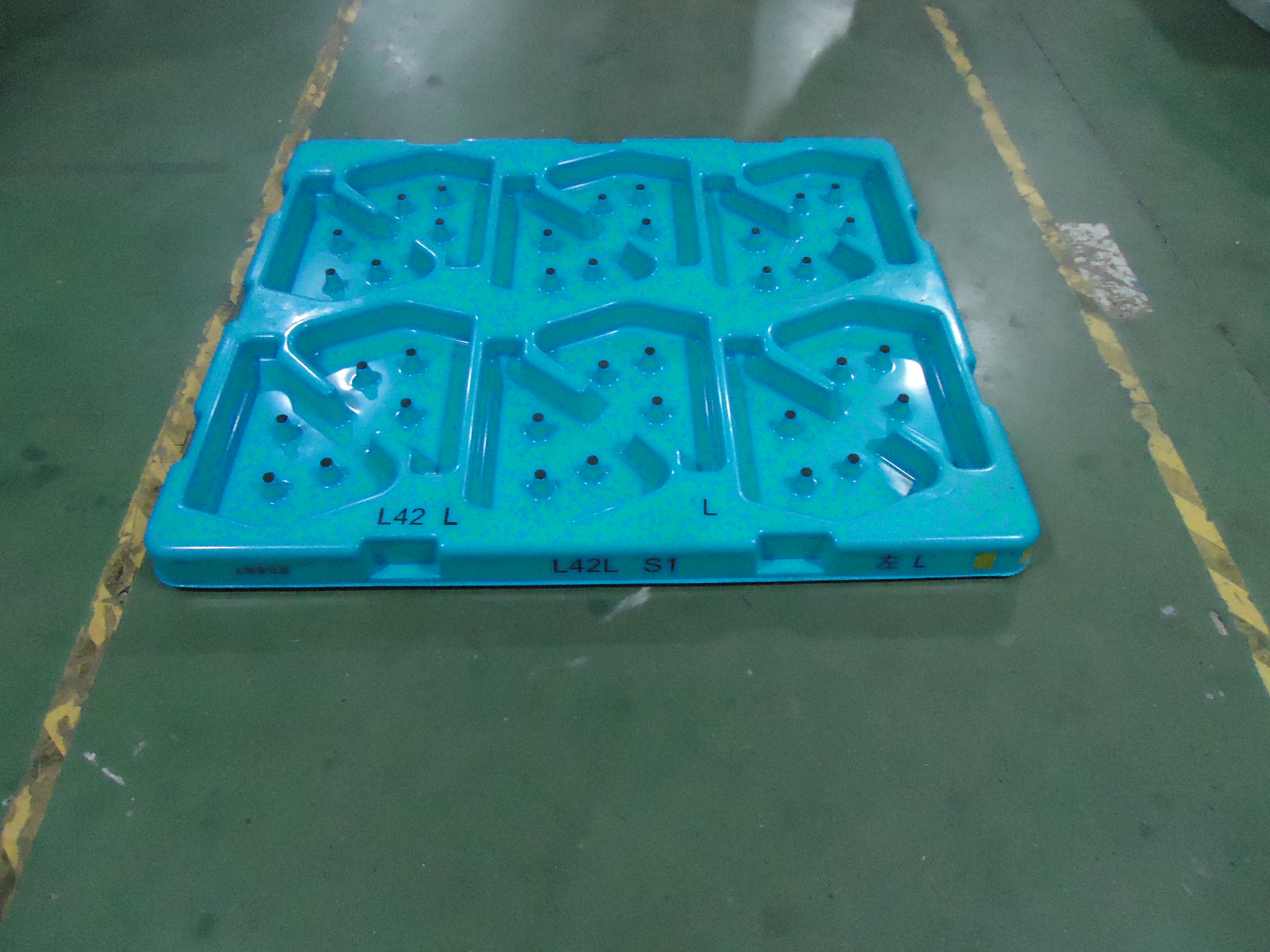
Accessory: anti-static blister tray for electrostatic-sensitive automotive or precision parts.
Supporting Equipment: Forklifts, Shelves and Logistics Systems
An enclosed pallet box is one node in a handling system, and the documented equipment set for this application type is forklift, warehouse shelf, logistics handling equipment and anti-static measures. Three practical implications follow.
First, fork entry has to be checked against the actual forklift fleet, not against a catalogue assumption. Second, because the box is nestable, empty-box storage volume drops when boxes are nested rather than stacked — a measurable warehouse-space benefit in a 24/7 operation. Third, because the boxes are designed to be stackable with an anti-slip interface, high-bay shelf storage is a realistic planning option rather than a manual-only arrangement. Buyers sourcing for a whole project should also state whether the box will sit on a pallet, directly on a shelf, or both, because that changes the base specification.
Testing and the 5-Year Guarantee: What Is Covered and What Is Not
Quality control at TOYOE follows a documented 50% test protocol, and the after-sales commitment is a 5-year guarantee. The guarantee carries two explicit exclusions: damage due to human error, and damage due to excessive storage weight of the product.
The first exclusion is a handling question — it is answered by training and by correct forklift practice. The second is a specification question, and it is the reason this guide treats the load boundary as a parameter. Because the TOYOE specification does not publish a numeric load rating for each model, buyers should not assume one: the correct path is to state the real load, including the inner lining and any tray, and have the supplier confirm the fit in writing before the order. That single step protects the guarantee and the project schedule at the same time.
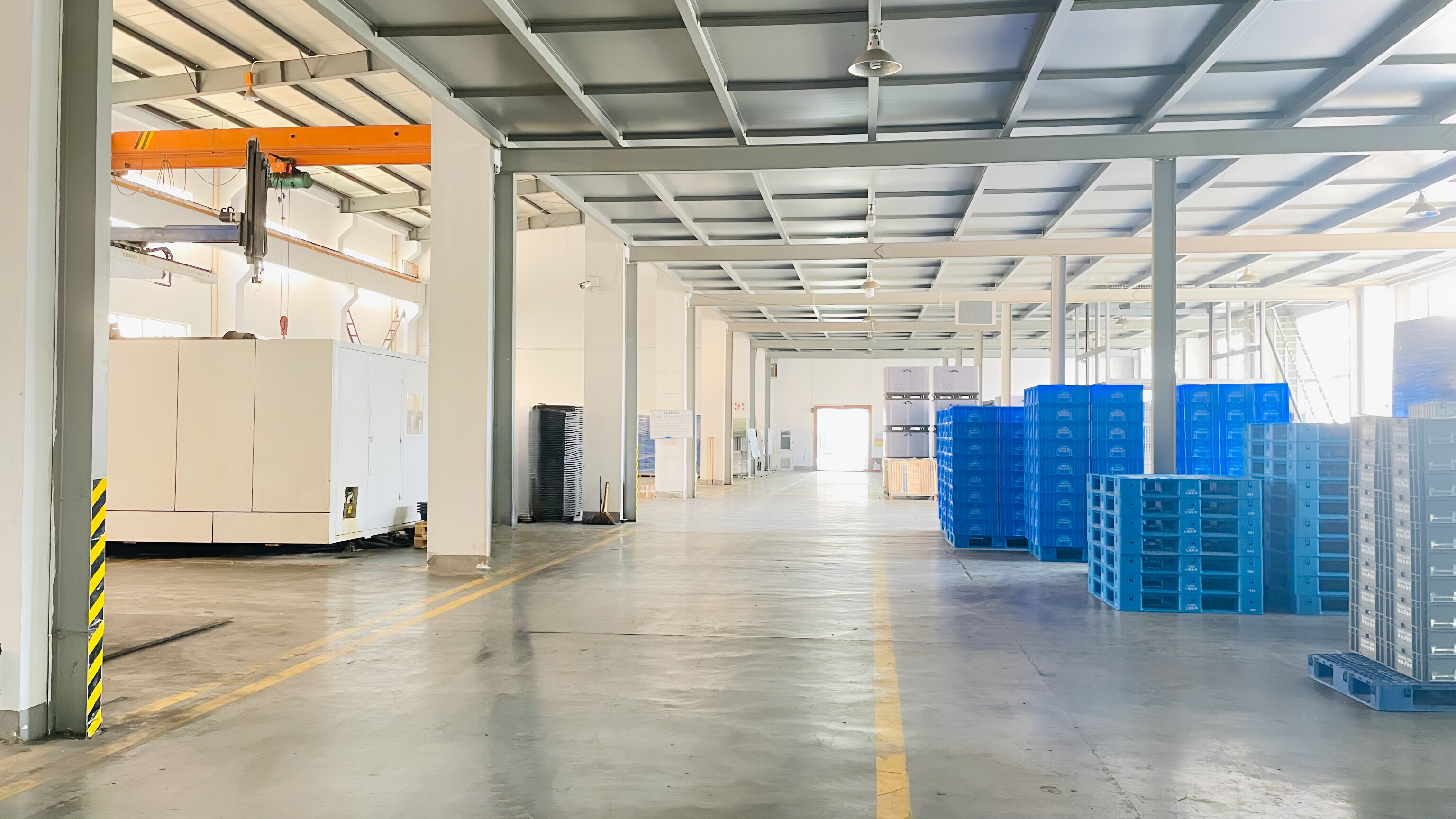
Proof: TOYOE manufacturing shop in Zhangjiagang, Suzhou, China — 30,000 units annual production capacity and a 50% test protocol.
Production scale matters for project risk. The documented capacity is 30,000 units per year and 3,000 pieces per month, with a 7–15 day lead time, which is relevant when a warehouse retrofit is scheduled in phases. Products are exported to markets including Mexico and the USA, as well as the EU and Southeast Asia.
Frequently Asked Questions
1. Which media and standards apply to an enclosed HDPE pallet box for chemical and auto parts storage?
The TOYOE enclosed pallet box specification lists its application media as oil, industrial alcohol, alkali, acid, industrial wastewater, water and car parts, and the box is documented as an enclosed type rather than an open one. For buyers writing a purchase specification for reusable box pallets in Europe, EN 13626:2003, published by CEN, is the primary European standard specifying requirements and test methods for reusable box pallets used for material handling. EN 13626:2003 addresses reusable box pallets as a product category; it is a test-method reference, not a certificate issued to any individual supplier or model.
2. Can dimension, colour, material and logo be customized, and can the box include an inner lining?
Yes. TOYOE operates an OEM/ODM production mode with customization of dimension, logo, colour and material, and logo printing is free. Sizes are documented as multiple specifications that can be customized, and custom orders are accepted. Inner lining options documented in the product range include a heavy-duty vacuum-formed inner lining tray, a booster vacuum-formed inner lining tray, a transmission blister inner lining tray and an anti-static blister tray. These trays are the element that holds a gearbox, engine part or precision component in a fixed position inside the enclosed box.
3. What drives the cost of an enclosed pallet box project?
Five documented factors drive cost. The first is the model and footprint: the 1200 × 800 × 1000 mm, 1000 × 800 × 800 mm and 1230 × 830 × 1000 mm die-cast boxes are separate specifications. The second is material, HDPE or PP. The third is the customization scope — dimension, colour, logo and material — where a non-standard dimension typically requires tooling work. The fourth is the inner lining, since a vacuum-formed or blister tray is an additional component. The fifth is order quantity and packaging, with production capacity documented at 3,000 pieces per month and 30,000 units per year, packing in plastic film, and MOQ set at 1 unit. TOYOE quotes per project rather than publishing a list price, because two projects with the same box size rarely have the same lining and tooling requirement.
4. Is a sample available, and how is quality controlled?
Samples are accepted across the TOYOE enclosed pallet box range, which allows a buyer to validate fit, inner lining position and stacking behaviour before committing to project volume. Quality control follows a documented 50% test protocol. A useful reference point for scale is the Mexico automotive programme, where an automobile manufacturer took 1,000 pieces for transmission gearbox storage and ran the boxes for 3 years, reporting standardized parts storage, avoided gearbox collision damage and improved warehouse management efficiency.
5. What is the lead time and what does the 5-year guarantee cover?
Production lead time is documented at 7–15 days, supported by a monthly capacity of 3,000 pieces and an annual capacity of 30,000 units. The after-sales commitment is a 5-year guarantee, excluding damage due to human error and damage due to excessive storage weight of the product. To protect that guarantee on a chemical or automotive project, state the real load and the handling method in the enquiry so the correct model, material and lining can be confirmed before production. You can send the load details through the TOYOE website at www.toyoebox.com, request a sample, or download the product catalogue to review the full enclosed pallet box range.
Conclusion: Specify the Parameter, Then Specify the Box
Enclosed HDPE and PP pallet boxes for chemical and auto parts storage are a specification problem before they are a purchasing problem. The three documented footprints — 1200 × 800 × 1000 mm, 1000 × 800 × 800 mm and the 1230 × 830 × 1000 mm die-cast model — cover the mainstream project sizes at a usable capacity of 100–200 L, in recyclable, durable and nestable construction, with enclosed walls for dust and moisture protection and an anti-slip base for stable stacking.
From there, the decision narrows to four questions: which medium, which handling interface, which lining, and which commercial terms. TOYOE answers the commercial sides with an MOQ of 1 unit, accepted samples, a 7–15 day lead time, a documented 50% test protocol, a 5-year guarantee with two clearly stated exclusions, and customization across dimension, colour, material and free logo printing.
Buyers who work through the eight specification steps in this guide usually find that the box they need is already in the documented range — and that the custom work belongs in the inner lining rather than in the shell.
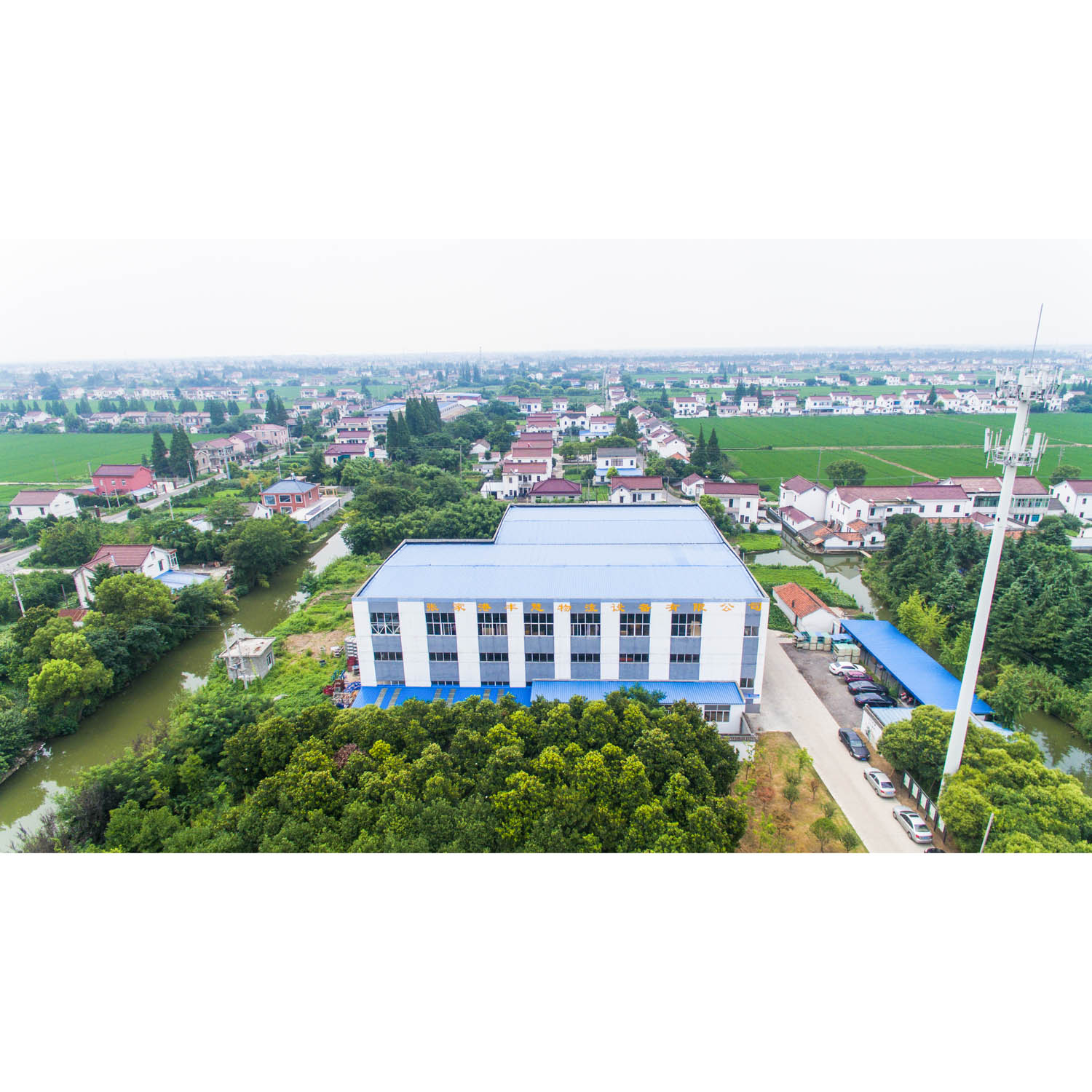
Next step: request a sample or a project quote, or download the TOYOE pallet box catalogue.
Request a Sample, Quote or the Product Catalogue
Send the medium, the load, the footprint and the handling method, and TOYOE will confirm the model, material and lining that fit the project.
Download the TOYOE product catalogue (PDF) | www.toyoebox.com
Have Questions or Need More Details?
Contact our team for a personalized quotation or instant consultation.
Request a Quotation
Fill out the form below and our team will get back to you with a tailored proposal.
WhatsApp Direct Chat
Prefer to chat in real-time? Message us on WhatsApp for instant assistance & quick answers.
- Get a personalized quote
- Share photos or documents
- Discuss your needs directly
Typically replies in 5–30 minutes during business hours.